What is the difference between a drum unit and a toner cartridge?
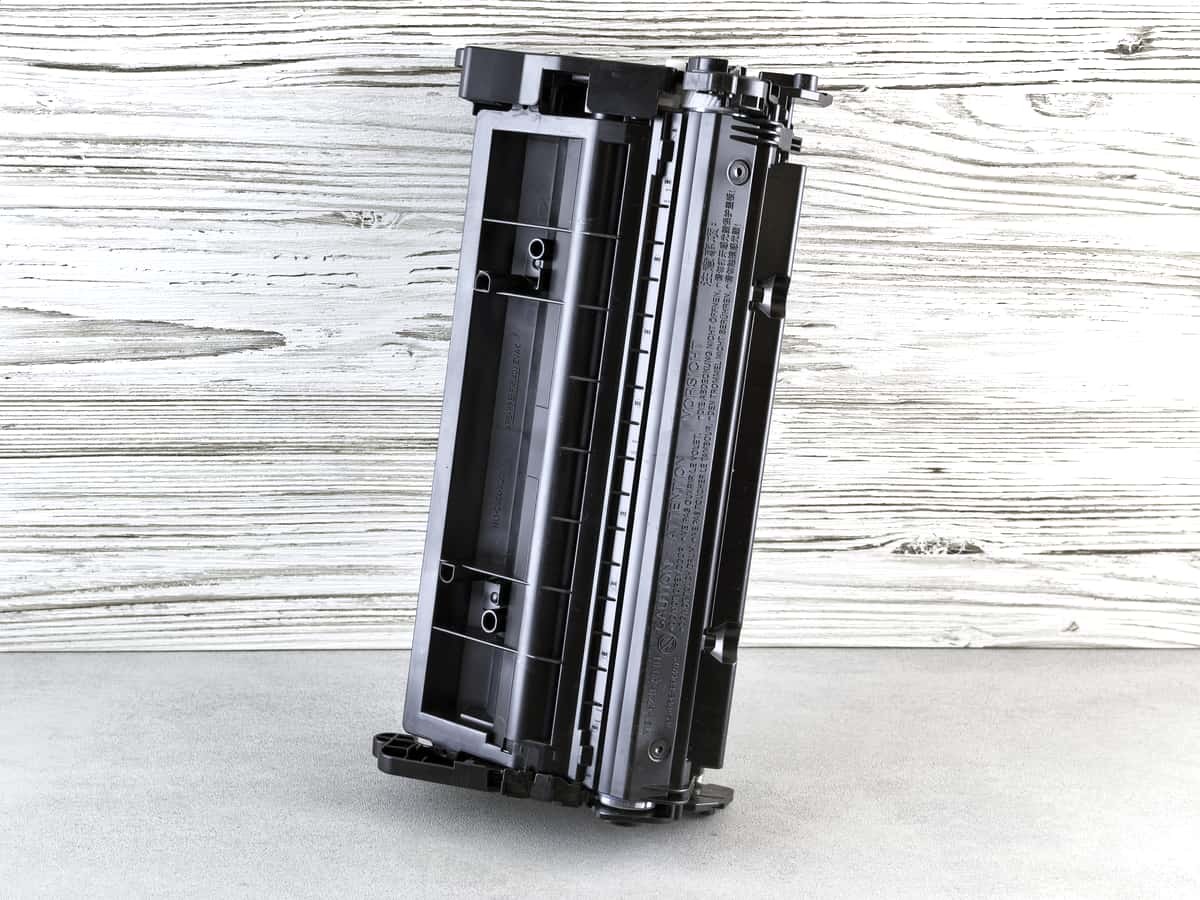
The toner cartridge holds the powder that becomes the print. The drum unit is the light-sensitive cylinder that picks that powder up in the shape of your page and transfers it to the paper. Toner is consumed by printing; the drum wears out slowly and lasts several cartridges.
How the two parts work together
A laser writes your page onto the drum as a pattern of electrical charge. Toner powder sticks to the charged areas, the drum rolls against the paper and hands the powder over, and a hot fuser melts it into the surface. The powder is spent on every page; the drum surface is only gradually abraded and fatigued by the process.
That is why the replacement intervals are so different. On the Brother machines we cover, a high-yield toner cartridge is rated at 3,000 pages while the drum is rated at approximately 15,000 — five cartridges to one drum. On the business range the ratio is wider still.
| Machine | Toner cartridge | Toner rating | Drum unit | Drum rating |
|---|---|---|---|---|
| HL-L2460DW | TN830 / TN830XL | 3,000 pages (XL) | DR830 | Approx. 15,000 pages |
| HL-L5210DW | TN920XXL | 11,000 pages | DR920 | Approx. 45,000 pages |
| HL-L6210DW | TN920UXXL | 18,000 pages | DR920 | Approx. 45,000 pages |
| HL-L3220CDW | TN229 / TN229XL | 3,000 pages (XL black) | Not published on the page we read | Not published |
Exactly as published on each Brother product page, recorded in our registry on the dates shown there. We have not priced drum units from a citable source and therefore publish no drum cost or drum cost per page anywhere on this site.
Some printers combine the two, and it costs you
Not every laser separates them. On many compact and budget machines — the Canon imageCLASS LBP6030w in our registry uses a cartridge of this type — the drum is built into the toner cartridge, so every time the powder runs out you throw away a functioning imaging drum and buy a new one.
That is a large part of why that machine has the dearest cost per page of anything we cover, at about 6.1 cents against about 3.3 cents on a Brother household cartridge. The convenience of one part instead of two is real; the price of it is roughly double per page, for years. The cheap-toner picks are all separate-part machines, which is not a coincidence.
Which part is causing your print quality problem?
- Fading, pale print, or paler at one side: toner. It is running low or settling unevenly. Take the cartridge out and rock it gently from side to side before replacing it.
- A mark or line that repeats at the same spacing down every page: drum. The repeat interval is the drum circumference, which is the giveaway.
- Gray background haze over the whole page: usually a worn or contaminated drum, sometimes a cheap toner that does not hold charge well.
- Print that smudges when rubbed: neither — that is the fuser not reaching temperature, or paper far heavier than the media setting.
- A panel warning saying replace drum: a page counter, not a measurement. Many printers keep producing perfect pages past it; replace when quality drops.
What this means when you buy
Ask two questions about any laser you are considering. Does it use a separate drum unit, and what is the drum rated for? A machine with a separate drum rated at tens of thousands of pages will cost you less per page for its entire life than a cheaper machine with an all-in-one cartridge, and it can be kept going with a part rather than retired.
Then check the cartridge yield, because that is the number that sets your cost per page. The spread on the cartridges we have priced runs from about 1.3 cents to about 6.1 cents for the same black page. What toner costs lays the figures out, and the calculator takes your own volume.
Color lasers add three more
A color laser needs the same mechanism for each of its four toners, so the parts list grows: four cartridges, and depending on the design either four drums, a single drum unit, or a belt and transfer assembly. Brother did not publish a drum specification for the HL-L3220CDW on the page we read, which is itself worth knowing before you buy it — a color laser total cost of ownership is a longer sum than a mono one, and it is a large part of why color toner pages cost several times what bottled ink does.
That is the case for keeping color on an ink tank printer and black text on a mono laser, if you print enough of both to care. Color laser vs ink tank sets the two out side by side.