#ad — buy links are affiliate links and we may earn a commission at no cost to you. How this site is funded. We do not display live prices, so every button sends you to Amazon’s own page for the current one. Cost-per-page figures are arithmetic on supply prices we read on 27 September 2026 — here is the method.
Most of this site argues that cost per page is the number that decides a printer purchase. This page is the exception, and it is an important one: if you print rarely, cost per page barely matters and reliability after neglect matters enormously.
How we picked
The selection criterion here is unusual: we ranked on tolerance of disuse rather than on running cost. That immediately puts lasers at the top, because toner is a dry powder that cannot dry out, and it pushes the tank printers we recommend everywhere else down the page.
We then checked the total cost at genuinely occasional volumes — ten to twenty-five pages a month — because at that level the purchase price dominates and the per-page figure is close to noise. One laser is in the comparison table as a warning: a cheap body with a low-yield cartridge is still the dearest option here even at low volume.
Why an inkjet struggles with being ignored
An inkjet fires liquid ink through microscopic nozzles. When the printer sits unused, ink at the nozzle face dries and can block it. Printers fight this automatically by running cleaning cycles, which consume ink that never reaches paper — so long idle periods cost you ink even though you printed nothing.
A tank printer is not worse at this than any other inkjet. It is just that people buy tank printers because ink is cheap, which sometimes means buying one for printing volumes too low to keep it healthy.
Why a laser does not care
Toner is a fine dry powder that is fused onto paper with heat. There is nothing to evaporate, nothing to clog, and no automatic maintenance consuming supplies in the background. Unopened toner keeps for years, and an installed cartridge is equally happy after six idle months. The longer answer, including what genuinely can degrade.
Three years of ownership at genuinely occasional volumes
10 pages a month
25 pages a month
Brother HL-L2460DW toner
about $12
about $29
Epson EcoTank ET-2800 ink
about $1
about $4
Difference in supplies over 3 years
a few dollars
under twenty dollars
Difference in list price
the Brother is cheaper to buy
the Brother is cheaper to buy
Supplies only, mono pages, at the rated yields and prices we read on 27 September 2026. The point of this table is that at occasional volumes the entire cost-per-page argument collapses into a rounding error — and the cheaper printer also happens to be the reliable one.
If you do buy an inkjet anyway
Print one page every couple of weeks. A color page, so all four channels move. This is the single most effective thing you can do and it costs a fraction of a cent.
Leave it plugged in and powered. It needs power to run its own maintenance cycles.
Do not run the tanks empty and leave them. Air in the lines is harder to recover from than low ink.
Expect to run a head clean occasionally after a long gap, and know that it uses ink.
Specifications and running costs side by side, for the printers discussed on this page.
Cost-per-page figures are our own arithmetic: supply price divided by the manufacturer’s rated page yield, using prices read on 27 September 2026 and yields rated at the ISO 5% coverage standard. They are not measured by us and they are not current prices. Every input, and the working · run the numbers for your own printing
The picks in detail
Best for occasional use overall
Brother HL-L2460DW
If you print black text and nothing else, this is the printer to buy. It cannot dry out, it duplexes, and Brother does not block third-party toner.
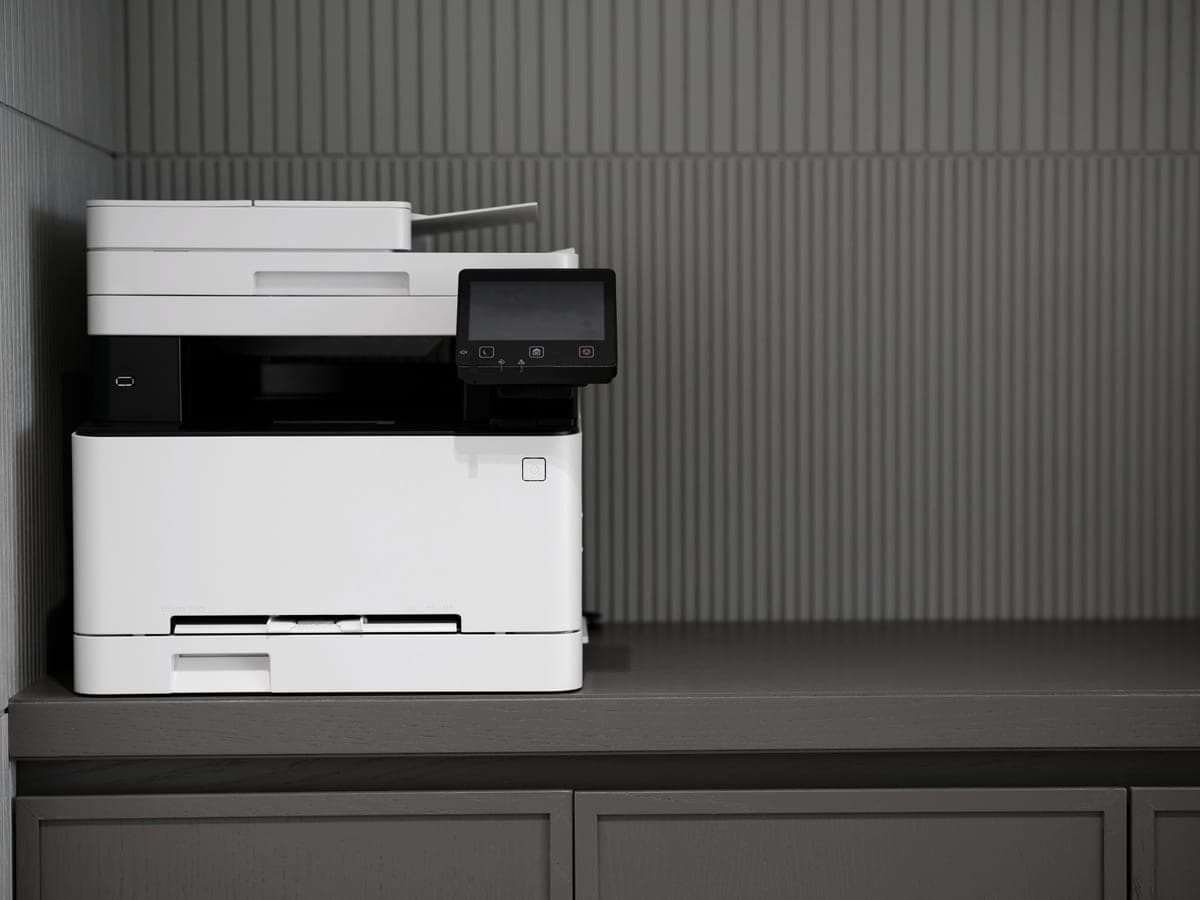
Illustrative photograph of this kind of printer. We do not have this model in hand and this is not a photograph of the unit.
#ad — we may earn a commission. How this site is funded. We do not show live prices; Amazon’s page is the price of record.
~3.3¢ per mono page
Based on a Brother TN830XL high-yield toner cartridge rated at 3,000 pages at $98.29, priced on 27 September 2026.
Brother TN830XL high-yield toner cartridge — rated 3,000 pages (ISO/IEC 19752), $98.29 at Brother USA, checked 27 September 2026
Yields are manufacturer-rated at the ISO 5% page-coverage standard, not measured by us, and real-world cost runs higher. Prices are not live: this is arithmetic on a price we read on the date shown, not a current price. How we calculate cost per page.
Dual-band wireless (2.4 GHz / 5 GHz), Ethernet or USB
Subscription
None required
What we like
Toner does not dry out, so it is ideal if you print in occasional bursts
Automatic two-sided printing at 36 pages per minute
Brother has publicly denied blocking third-party toner with firmware
What you give up
Black only - no color at all
Cost per page is roughly ten times a tank printer's
The 700-page starter cartridge runs out fast; budget for a TN830XL
If you print in unpredictable bursts, this is the printer. Toner is a dry powder: no solvent to evaporate, no print head to block, no maintenance cycle quietly consuming supplies while the machine sits idle. Leave it from January to May and it prints in May.
It costs about 3.3 cents a page against a tank printer’s 0.4 of a cent, and at genuinely occasional volumes that difference is a few dollars a year. Reliability is worth more than a few dollars.
#ad — we may earn a commission. How this site is funded. We do not show live prices; Amazon’s page is the price of record.
~3.3¢ per mono page
Based on a Brother TN830XL high-yield toner cartridge rated at 3,000 pages at $98.29, priced on 27 September 2026.
Brother TN830XL high-yield toner cartridge — rated 3,000 pages (ISO/IEC 19752), $98.29 at Brother USA, checked 27 September 2026
Yields are manufacturer-rated at the ISO 5% page-coverage standard, not measured by us, and real-world cost runs higher. Prices are not live: this is arithmetic on a price we read on the date shown, not a current price. How we calculate cost per page.
50-page document feeder, so scanning a stack is one action
Auto duplex printing at 36 pages per minute
Same TN830 toner family as the HL-L2460DW, with the same cost per page
What you give up
Mono only
Thirty dollars more than the print-only model for hardware you may not need
Toner is far dearer per page than bottle ink
The same print engine, the same TN830 toner and therefore the same cost per page, with a scanner and a fifty-page document feeder added. About thirty dollars more at list price when we checked.
Worth it if the occasional job you print is often accompanied by an occasional thing you need to scan — a form, a signed document, a receipt.
#ad — we may earn a commission. How this site is funded. We do not show live prices; Amazon’s page is the price of record.
~0.4¢ per mono page · ~1.1¢ per color page
Based on a Epson 522 black ink bottle rated at 4,500 pages at $17.99, priced on 27 September 2026.
The color figure adds one per-page cost for each of the three color channels, because an ISO color page draws from all of them.
Epson 522 black ink bottle — rated 4,500 pages (ISO/IEC 24712), $17.99 at Epson US, checked 27 September 2026
Epson 522 color ink bottle — rated 7,500 pages (ISO/IEC 24712), $17.99 at Epson US, checked 27 September 2026
Yields are manufacturer-rated at the ISO 5% page-coverage standard, not measured by us, and real-world cost runs higher. Prices are not live: this is arithmetic on a price we read on the date shown, not a current price. How we calculate cost per page.
Among the lowest cost per page of any printer sold for home use
Refillable bottles, so no chipped cartridge can be locked out by firmware
Comes with enough ink in the box to last most households a long time
What you give up
No automatic two-sided printing, so paper costs twice what it needs to
Flatbed scanner only - no document feeder for multi-page scans
Inkjets still need to be used occasionally or the print head can clog
Sometimes occasional printing includes color that a mono laser cannot do, and a color laser is a lot of money for a few pages. In that case a tank printer is the sensible compromise — and it comes with an obligation attached.
Print something, anything, every couple of weeks. One color page costs a fraction of a cent and keeps the print heads wet. Nearly every clogged tank printer story starts with months of complete disuse, and this one habit prevents almost all of it.
A mono laser — the Brother HL-L2460DW if you only print, the DCP-L2640DW if you also scan. Toner cannot dry out, so weeks or months of neglect cost you nothing, and at occasional volumes its higher cost per page adds up to very little.
+−Do ink tank printers dry out if not used?
They can. They are inkjets, so ink at the nozzle face can dry and clog if the printer sits unused for long periods. Printing one page every couple of weeks prevents almost all of it, and the printer also runs cleaning cycles on its own, which consume ink.
+−Is a laser printer better than an inkjet if I rarely print?
Yes, clearly. It is cheaper to buy, it is immune to drying out, and at low volumes its higher cost per page amounts to a few dollars a year. The only reason to choose an inkjet is if you need color.
+−How often should I use an inkjet printer to keep it healthy?
Roughly every two weeks, printing at least one page that uses all the color channels. That keeps the print head wet and is the cheapest maintenance available — a fraction of a cent a time on a tank printer.
+−Does unopened toner go bad?
Not in any practical sense. Unopened toner keeps for years in a cool, dry place, which is another reason a laser suits someone who prints unpredictably. How long toner lasts.