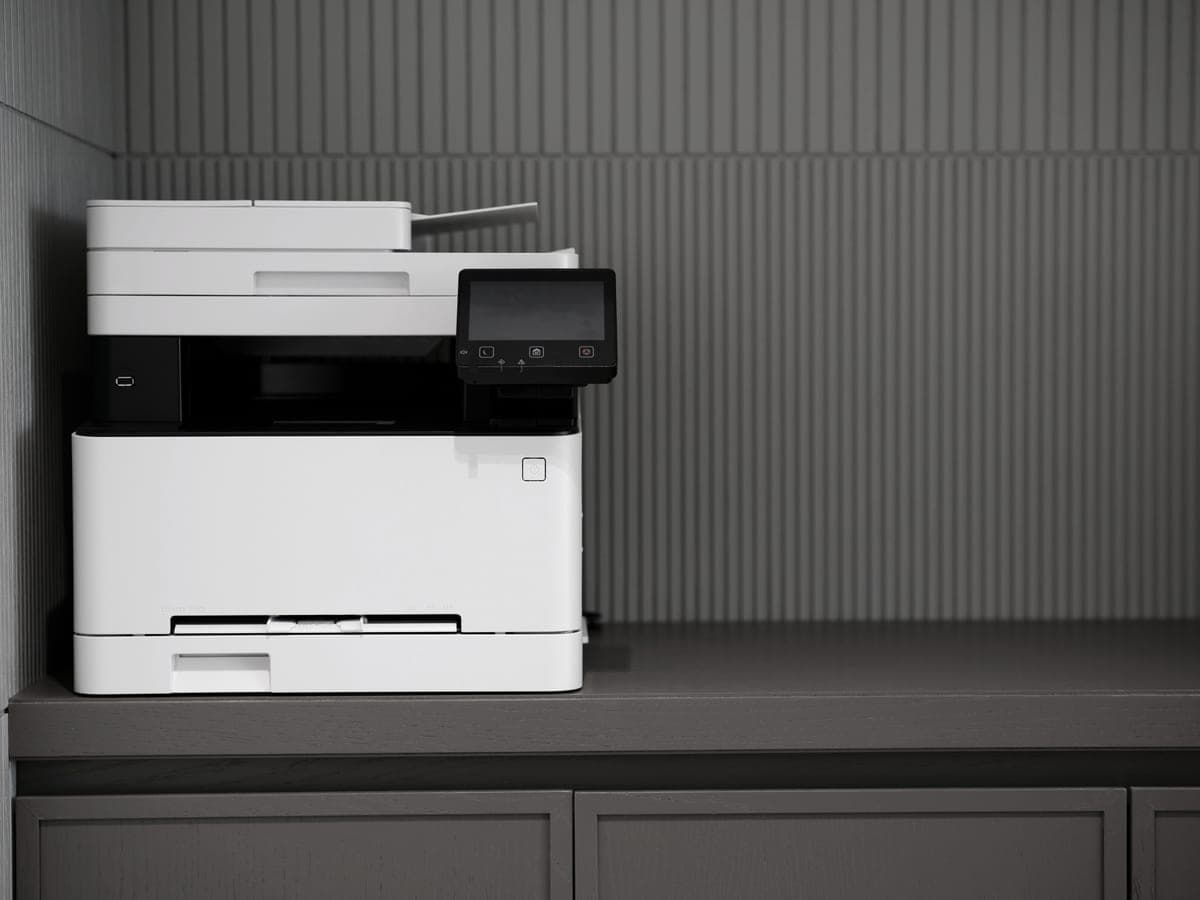
For envelopes, buy a laser with a multi-purpose tray: the Brother HL-L5210DW at $329.99 is the cheapest one we cover, and the HL-L6210DW at $349.99 is the one to buy if the job is a mailing run rather than a card. If envelopes are a once-a-year event, the MFC-L2820DW and its single-sheet manual slot will do it for $279.99 and scans as well.
How we picked
An envelope is thicker than paper, uneven in thickness across its width, folded in three layers at the seams and carries adhesive. Print quality is not the hard part; getting it through the machine straight and keeping it away from the tightest bends is. So we ranked on the published paper sources first and everything else second.
Brother does not publish an envelope capacity or a media weight on the product pages we read. We have not printed an envelope on any of these machines — we have no units and no lab. What follows is each manufacturer published paper handling plus our own cost arithmetic, and where a figure is missing we say so.
Why laser beats inkjet on an envelope
- The print is dry. Toner is fused on the surface, so an address cannot smudge in a mail sack and cannot run if the envelope meets rain between your door and the mailbox.
- Nothing soaks in. Envelope paper is absorbent and unsized compared with office paper. Liquid ink spreads along the fibres and a crisp address turns furry.
- It is fast and unattended. Thirty envelopes from a multi-purpose tray takes under a minute on a 48-page-a-minute laser.
- Mono is all you need. An address is black text. This is the one printing job where the cheapest-to-run technology is also the correct one — our monochrome picks.
| Printer | Second paper source | Speed | List price | Per page |
|---|---|---|---|---|
| Brother HL-L5210DW | 100-sheet multi-purpose tray | Up to 48 ppm | $329.99 | ~1.9¢ |
| Brother HL-L6210DW | 100-sheet multi-purpose tray | Up to 50 ppm | $349.99 | ~1.3¢ |
| Brother MFC-L2820DW | Single-sheet manual feed slot | Up to 34 ppm | $279.99 | ~3.3¢ |
| Brother HL-L2460DW | Not published | Up to 36 ppm | $179.99 | ~3.3¢ |
| Canon imageCLASS LBP6030w | Not published | Not published | Not published | ~6.1¢ |
Paper sources and speeds exactly as published on each manufacturer product page, recorded in our registry. Where a specification was not published we print that rather than guess. Cost per page is our arithmetic on genuine cartridge prices and manufacturer-rated ISO yields.
The pattern is the same one that shows up on every paper-handling question: the two business-range Brothers publish a second tray, the household models do not, and the machine with the cheapest sticker price is also the one with the least published about how it feeds anything unusual.
Printing envelopes without ruining them
- Load from the multi-purpose tray or manual slot, never the main cassette. The cassette route is longer and has more bends.
- Set the media type to Envelope in the print dialog. On a laser this slows the sheet and changes fuser behaviour, which is what stops a seam ghosting through.
- Keep the flap open and outside the path, and do not run envelopes with exposed adhesive through a laser. A fuser is hot by design and glue is the one material you do not want melting inside it.
- Set the correct envelope size in the driver — a US number 10 is 4.125 by 9.5 inches, an A7 is 5.25 by 7.25 — and print one test envelope before committing a box.
- Turn automatic duplexing off. There is nothing on the back of an envelope and the duplex path is the tightest route through the machine.
- For a mailing, use your word processor mail-merge rather than retyping. Every major office suite has an envelope layout built in, and no app or cloud account is needed for any of it.
What an envelope costs to print
Only the toner is ours to calculate: the envelope itself is paper you buy by the box. On the cartridge side the spread is almost threefold. A hundred addressed envelopes a month for three years costs $48 in toner on the HL-L6210DW against $118 on the household TN830XL family, and $218 on the Canon imageCLASS.
| Cartridge | Rated yield | Price we read | Per page |
|---|---|---|---|
| Brother TN830XL high-yield toner cartridge | 3,000 pages | $98.29 | ~3.3¢ |
| Brother TN830 standard-yield toner cartridge | 1,200 pages | $60.99 | ~5.1¢ |
| Brother TN229XL black high-yield toner cartridge | 3,000 pages | $96.29 | ~3.2¢ |
| Canon 125 black toner cartridge | 1,600 pages | $96.95 | ~6.1¢ |
Yields are manufacturer-rated (ISO/IEC 19752 for mono, 19798 for color); prices read on 27 September 2026 from the sources at the foot of this page. Our arithmetic is supply price divided by rated yield — the method.
An address uses far less toner than a full page of text, so treat those figures as the worst case at ISO coverage rather than a prediction. The ranking between them does not change. Run your own numbers.