A laser printer’s cost per page is not a property of the printer. It is a property of the cartridge the printer is designed to accept, and the range across the lasers on this site is wide: from about 1.3 of a cent a page to about 6.1 cents. Same technology, same black text, nearly five times the money.
What does a laser printer cost per page?
On the models we have priced, between about 1.3 and 6.1 cents a mono page: 1.3¢ on Brother’s ultra high-yield TN920UXXL, about 3.3¢ on a household TN830XL, and about 6.1¢ on Canon’s 125 cartridge. Published industry figures put mono laser printing around 5 to 8 cents a page, per Toner Buzz. Every figure here is a supply price divided by a manufacturer’s rated yield, with both shown.
Every laser we cover, ranked by cost per page
| Printer | Black cartridge | Rated yield | Price we read | Cost per page |
|---|---|---|---|---|
| Brother HL-L6210DW | Brother TN920UXXL ultra high-yield toner cartridge | 18,000 | 241.49 | ~1.3¢ |
| Brother HL-L5210DW | Brother TN920XXL super high-yield toner cartridge | 11,000 | 204.29 | ~1.9¢ |
| Brother HL-L3220CDW (color laser, black only) | Brother TN229XL black high-yield toner cartridge | 3,000 | 96.29 | ~3.2¢ |
| Brother HL-L2460DW / DCP-L2640DW / MFC-L2820DW | Brother TN830XL high-yield toner cartridge | 3,000 | 98.29 | ~3.3¢ |
| The same printers on the standard cartridge | Brother TN830 standard-yield toner cartridge | 1,200 | 60.99 | ~5.1¢ |
| Canon imageCLASS LBP6030w | Canon 125 black toner cartridge | 1,600 | 96.95 | ~6.1¢ |
Supply prices read from each manufacturer's own store on the dates in our sources, except the Canon 125, which Canon would not price for us and is therefore a retailer listing. Yields are the manufacturer's rating at ISO 5% coverage.
Three things fall out of that table that no specification sheet tells you. Cartridge size, not brand, sets the cost per page. Two printers from the same maker in the same year can differ by a factor of two. And the standard cartridge is always the expensive one.
Why office lasers are cheaper per page than household ones
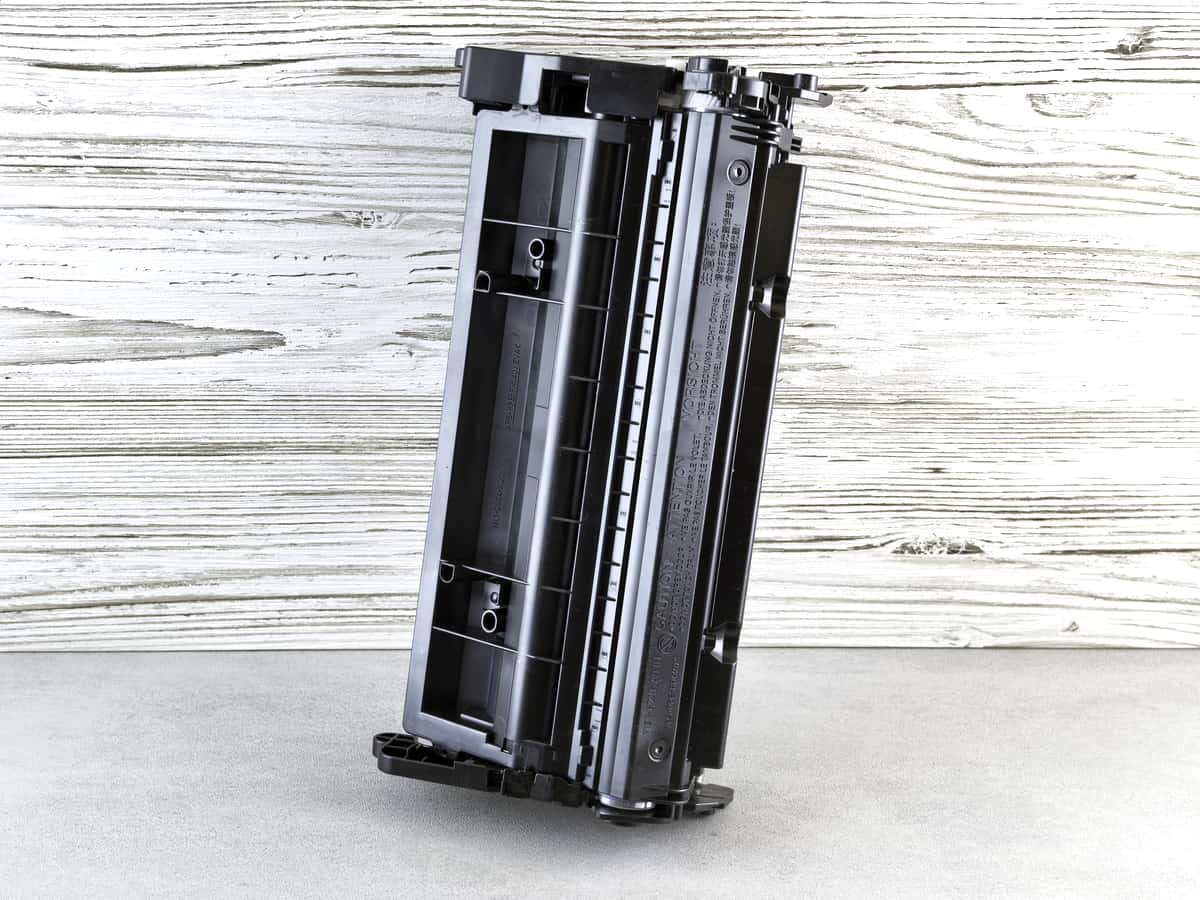
It looks backwards and it is not. A toner cartridge’s price does not scale with its capacity: Brother’s TN920UXXL holds fifteen times the pages of a TN830 and costs about four times as much. The toner itself is cheap; the plastic housing, the chip, the box and the shipping are not, and those are paid once per cartridge however much powder is inside.
So the business-class printer is cheaper to run precisely because it is designed around a big cartridge. The household printer is cheaper to buy and the difference is recovered from you later, a cartridge at a time. That is the single most useful thing on this page: the cost-per-page decision is made in the shop, not at the checkout for consumables.
The two costs the headline figure leaves out
The drum unit
Lasers have a second consumable. The imaging drum wears separately from the toner and is replaced on its own — Brother rates the DR830 used by its household lasers at around 15,000 pages. At 25 pages a month you will never reach it. At 300 a month you will meet it in about four years, and it is a real line item that almost no roundup counts. Drum versus toner, explained.
The starter cartridge
New lasers ship with a part-filled cartridge. Brother publishes 700 pages for the starter toner in its household mono lasers and 1,000 pages per color on the HL-L3220CDW. That is disclosed rather than hidden, but it means the first cartridge bill arrives sooner than a 3,000-page yield suggests. Budget for one high-yield cartridge in year one and the printer will not surprise you.
Why your real cost will be higher than every figure here
Every rated yield on this page assumes ISO 5% page coverage, which Toner Buzz describes as page yields are based on printing with 5% page coverage, which Toner Buzz describes as "approximately one-third of a page of double-spaced text". If your pages are denser than that — tables, bold headings, a logo on every invoice, anything with a filled area — your cartridge runs out sooner and your true cost per page is above ours.
We publish the rated figure anyway, because it is the only number that is comparable between printers and because it is the number the manufacturer stands behind. Treat it as a floor rather than a forecast. The full method, with the formula.
Laser against a tank printer, at your volume
A cost per page only becomes money when you multiply it by how much you print, and that is where the laser argument changes shape.
| If you print | Canon 125 (~6.1¢) | TN830XL (~3.3¢) | TN920UXXL (~1.3¢) | Epson 502 ink (~0.3¢) |
|---|---|---|---|---|
| 50 pages a month | $109 | $59 | $24 | $6 |
| 150 pages a month | $327 | $177 | $72 | $18 |
| 400 pages a month | $873 | $472 | $193 | $48 |
Supplies only - the printer's purchase price is not included. Mono pages at the manufacturer's rated yield and the supply prices in our sources.
At 50 pages a month every column is a small number and the cost per page is nearly irrelevant; buy whichever printer suits your paperwork. At 400 pages a month the columns are hundreds of dollars apart, the cartridge choice matters more than the printer did, and bottled ink is in a different category entirely.
The crossover for most people sits somewhere between 50 and 100 pages a month: below it, a laser’s lower purchase price usually wins overall; above it, a tank printer pulls ahead and keeps going. Color tips it to the tank printer at almost any volume. The full comparison · every printer we cover, ranked by running cost.
What to do with this number
- Check the cartridge before the printer. Look up the high-yield cartridge for any laser you are considering, divide its price by its rated yield, and you have the figure that will govern the next five years.
- Always buy high yield. On every family we have priced, the bigger cartridge is cheaper per page. The only reason to buy the small one is cash flow.
- Count the drum if you print a lot. Above a couple of hundred pages a month, add the drum to the sum. Below that, ignore it.
- Do not pay for a cost per page you will never use. A 1.3-cent page is worth nothing to someone printing twenty pages a month. Run your own volume before paying for a business cartridge.