
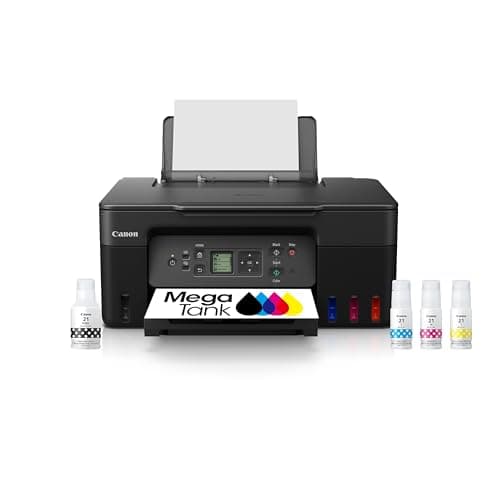
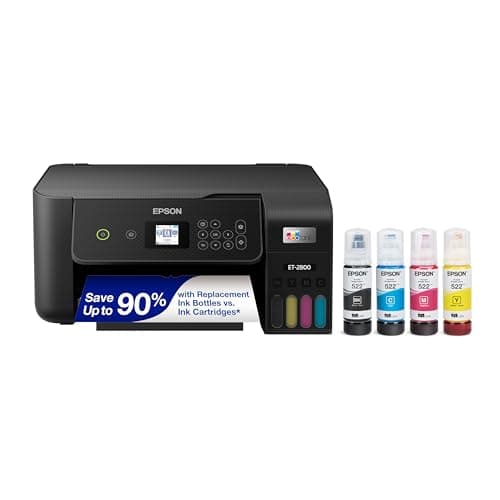
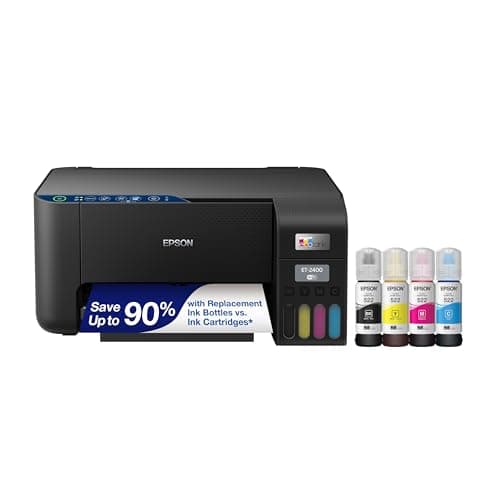
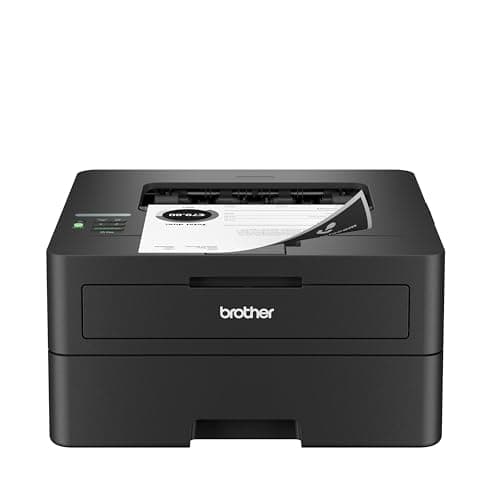
The low-maintenance tank printer to buy is the Canon MegaTank G3270, for a household that prints in bursts: a pigment black rather than a dye black, large bottles, and about 0.8 cents an ISO color page. The budget pick is the Epson EcoTank ET-2400 at $189.99. And the honest answer, if your printer will truly sit unused for months, is the Brother HL-L2460DW — a mono laser, because dry toner cannot dry out at all.
Which printer is best if you hardly ever print?
A mono laser, if black text is all you need: toner is a dry powder, so nothing evaporates and nothing clogs. If you need color, a refillable ink tank printer is the next best thing — not because the heads never block, but because at under a cent a page a cleaning cycle costs nothing, so recovery is cheap. The expensive failure mode is a cartridge printer, where clearing a blockage burns ink you paid a lot for.
How we picked
There is no published “maintenance” specification, so we ranked on the four things that actually decide whether a printer survives neglect.
- Is the black ink pigment or dye? Pigment sits on the paper rather than soaking in. Only the Canon publishes it at this price, and black text after a gap is the commonest complaint.
- What does a cleaning cycle cost? This is the real answer. Under a cent a page, you run the cycle without thinking. At cartridge prices, people put it off, and putting it off is what turns a soft blockage into a hard one.
- Can you see the ink? Transparent tanks replace a software estimate with a fact, which removes an entire category of false alarm.
- Would a laser be the better answer? For long idle periods, yes, and we rank one here rather than pretending otherwise.
What actually goes wrong when a printer sits
An inkjet lays down liquid ink through very fine nozzles. When the machine is idle, ink at the nozzle face is exposed to air, and the solvent in it evaporates. What is left behind is thicker than what the nozzle was designed to pass, and when you finally print, some nozzles fire and some do not — which shows up as banding, missing color or gray text instead of black.
That is the whole mechanism, and it explains the fix. Printers run cleaning cycles that push ink through the nozzles to clear them, and the cycles work. The reason this problem has a reputation is economic rather than technical: on a cartridge printer each cycle spends real money, so owners avoid them. On a bottle-fed machine the same cycle costs a fraction of a cent, so you use the tool the printer gives you. Whether ink tank printers clog, in detail.
| Printer type | Cost of a mono page | What a cleaning cycle feels like |
|---|---|---|
| Canon MegaTank, GI-21 bottles | ~0.3¢ | Free, in practice |
| Epson EcoTank, 522 bottles | ~0.4¢ | Free, in practice |
| Cartridge inkjet, published range | about 7.5 cents a page | Something you put off |
| Mono laser, high-yield toner | ~3.3¢ | Not applicable - nothing to clean |
Per-page figures are our arithmetic on dated published supply prices divided by rated ISO yields — the method. The cleaning column is reasoning from those costs, not a measured ink volume.
The one habit that prevents most of it
Print something in color every couple of weeks. A single page with all four channels on it moves ink through every nozzle and keeps the heads wet, and it takes ten seconds. This is more effective than any purchase decision on this page, and it is free. Leaving the printer powered on also helps, because most machines run a short maintenance routine on their own schedule.
The failure case to avoid is the one most households create accidentally: a printer bought for color, used only for black text, and unplugged between uses. The color channels sit unused for months and then surprise you on the day you need a photo. What actually determines a printer’s life.
When to stop reading this page and buy a laser
If you print fewer than roughly ten pages a month, they are almost all black text, and the printer lives in a spare room, a mono laser is the right machine and this entire category of problem disappears. We would rather send you there than sell you a tank printer you will be disappointed by. The laser printers we recommend for home use · whether a laser is worth it for you.