These two brands barely compete. Brother is strongest where Epson does not really play, and Epson owns the category Brother's lasers cannot serve affordably.
#ad — buy links are affiliate links and we may earn a commission at no cost to you. How this site is funded. We do not display live prices, so every button sends you to Amazon’s own page for the current one. Cost-per-page figures are arithmetic on supply prices we read on 27 September 2026 — here is the method.
Brother or Epson: which printer brand is better?
Neither, because they are strongest at different things. Buy Brother for a mono laser: reliable, fast, duplexing, and unaffected by sitting idle. Buy Epson for cheap color: an EcoTank prints a color page for about 1.1 of a cent, which no Brother laser can approach.
Brand comparisons are usually the least useful kind, because a brand is not a product. This one is worth writing only because these two companies have unusually little overlap: each is dominant in a category the other barely serves.
How we approached this
By comparing the products rather than the companies. For each brand we took the models we actually recommend, priced their supplies from the manufacturers’ own stores, and set them against each other by use case rather than head to head — because a mono laser and a color tank printer are not competing for the same job.
We also read the 2025 reporting on Brother and third-party toner in full, since supply policy is a genuine brand-level consideration and is one of the few things that legitimately belongs in a brand comparison.
Where each brand wins
Brother and Epson, by what they are actually good at
Brother
Epson
Core technology
Laser (mono and color)
Refillable ink tank (EcoTank)
Cheapest black page
~3.3¢ (TN830XL)
~0.3¢ (502 ink)
Cheapest color page
between 12 and 15 cents a page (industry range)
~1.1¢
Photographs
No
Yes, and a dedicated photo model
Tolerates months of disuse
Yes
Needs occasional use
Speed
Up to 36 pages a minute
Modest
Range breadth in its category
Several mono models, a few color
The broadest tank range on sale
Supply format
Cartridge with a chip
Bottle with no chip
Our cost figures are arithmetic on prices read 27 September 2026; the color laser range is Toner Buzz’s. The last row is the one that matters most for supply freedom.
Supply policy, which is a real brand-level question
This is the one dimension where comparing companies rather than products is legitimate.
Epson
On EcoTank models the question largely does not arise: you pour ink from a bottle into a reservoir, and a bottle has no chip to authenticate. That is a structural exemption rather than a policy, which makes it more durable than any corporate assurance.
Brother
Brother has long had the best reputation among people who want to use compatible cartridges, and in early 2025 that was publicly challenged: allegations circulated that firmware updates were blocking third-party toner. Brother denied it directly, telling Ars Technica that “Brother firmware updates do not block the use of third-party ink in our machines”, while noting it performs a genuine-supply check during troubleshooting.
We treat that as an unresolved dispute and set out both sides with sources on its own page. The practical conclusion is unchanged: if certainty about supplies is the goal, a bottle beats any cartridge from any brand.
The decision, which is not really about brand
You print color. Epson. There is no Brother product that competes on cost.
You print black text, rarely. Brother. Cheaper to buy and immune to idle time.
You print black text, in volume, at speed. Brother, and it is not close on throughput.
You print photographs. Epson, and specifically its photo tank model.
You want certainty about supplies. Epson EcoTank, for the structural reason above.
Specifications and running costs side by side, for the printers discussed on this page.
Cost-per-page figures are our own arithmetic: supply price divided by the manufacturer’s rated page yield, using prices read on 27 September 2026 and yields rated at the ISO 5% coverage standard. They are not measured by us and they are not current prices. Every input, and the working · run the numbers for your own printing
The picks in detail
Brother's strongest product
Brother HL-L2460DW
If you print black text and nothing else, this is the printer to buy. It cannot dry out, it duplexes, and Brother does not block third-party toner.
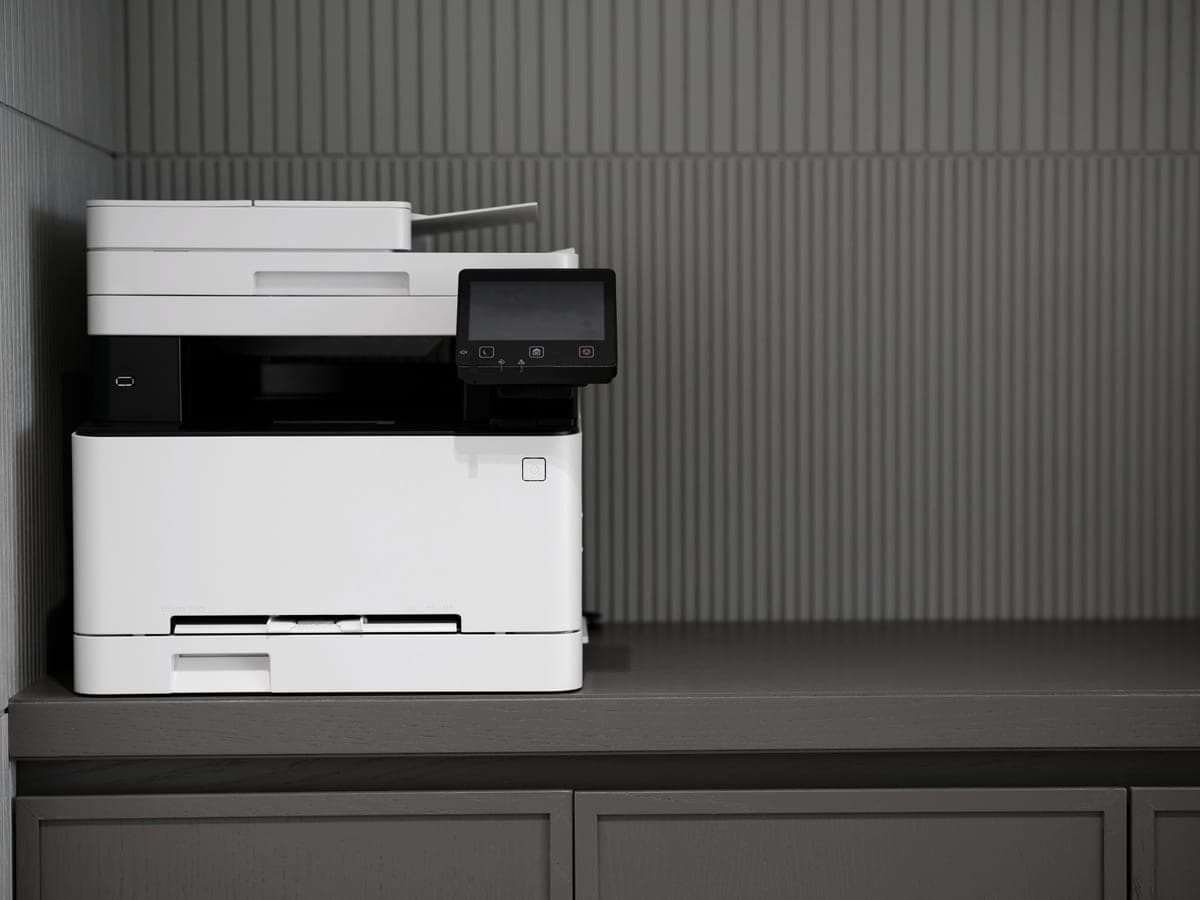
Illustrative photograph of this kind of printer. We do not have this model in hand and this is not a photograph of the unit.
#ad — we may earn a commission. How this site is funded. We do not show live prices; Amazon’s page is the price of record.
~3.3¢ per mono page
Based on a Brother TN830XL high-yield toner cartridge rated at 3,000 pages at $98.29, priced on 27 September 2026.
Brother TN830XL high-yield toner cartridge — rated 3,000 pages (ISO/IEC 19752), $98.29 at Brother USA, checked 27 September 2026
Yields are manufacturer-rated at the ISO 5% page-coverage standard, not measured by us, and real-world cost runs higher. Prices are not live: this is arithmetic on a price we read on the date shown, not a current price. How we calculate cost per page.
Dual-band wireless (2.4 GHz / 5 GHz), Ethernet or USB
Subscription
None required
What we like
Toner does not dry out, so it is ideal if you print in occasional bursts
Automatic two-sided printing at 36 pages per minute
Brother has publicly denied blocking third-party toner with firmware
What you give up
Black only - no color at all
Cost per page is roughly ten times a tank printer's
The 700-page starter cartridge runs out fast; budget for a TN830XL
Brother is at its best here: a straightforward mono laser at $179.99 with automatic duplexing, 36 pages a minute, and a high-yield cartridge rated at 3,000 pages. Nothing Epson sells competes with it directly.
Brother is also the brand most often recommended by people who want the option of compatible cartridges, though that reputation was publicly tested in 2025 — we cover the dispute in full.
#ad — we may earn a commission. How this site is funded. We do not show live prices; Amazon’s page is the price of record.
~0.4¢ per mono page · ~1.1¢ per color page
Based on a Epson 522 black ink bottle rated at 4,500 pages at $17.99, priced on 27 September 2026.
The color figure adds one per-page cost for each of the three color channels, because an ISO color page draws from all of them.
Epson 522 black ink bottle — rated 4,500 pages (ISO/IEC 24712), $17.99 at Epson US, checked 27 September 2026
Epson 522 color ink bottle — rated 7,500 pages (ISO/IEC 24712), $17.99 at Epson US, checked 27 September 2026
Yields are manufacturer-rated at the ISO 5% page-coverage standard, not measured by us, and real-world cost runs higher. Prices are not live: this is arithmetic on a price we read on the date shown, not a current price. How we calculate cost per page.
Among the lowest cost per page of any printer sold for home use
Refillable bottles, so no chipped cartridge can be locked out by firmware
Comes with enough ink in the box to last most households a long time
What you give up
No automatic two-sided printing, so paper costs twice what it needs to
Flatbed scanner only - no document feeder for multi-page scans
Inkjets still need to be used occasionally or the print head can clog
Epson invented this category and still has the broadest range in it. About 1.1 of a cent a color page, print, scan and copy, no cartridge and therefore no chip. Brother has nothing that competes on cheap color.
The EcoTank range also has the practical advantage of breadth: if you later want a duplexer, a feeder or Ethernet on the same ink, there is a model that has it.
#ad — we may earn a commission. How this site is funded. We do not show live prices; Amazon’s page is the price of record.
~3.3¢ per mono page
Based on a Brother TN830XL high-yield toner cartridge rated at 3,000 pages at $98.29, priced on 27 September 2026.
Brother TN830XL high-yield toner cartridge — rated 3,000 pages (ISO/IEC 19752), $98.29 at Brother USA, checked 27 September 2026
Yields are manufacturer-rated at the ISO 5% page-coverage standard, not measured by us, and real-world cost runs higher. Prices are not live: this is arithmetic on a price we read on the date shown, not a current price. How we calculate cost per page.
50-page document feeder, so scanning a stack is one action
Auto duplex printing at 36 pages per minute
Same TN830 toner family as the HL-L2460DW, with the same cost per page
What you give up
Mono only
Thirty dollars more than the print-only model for hardware you may not need
Toner is far dearer per page than bottle ink
All-in-ones are the one place these brands genuinely compete for the same buyer. A Brother mono laser all-in-one is faster, duplexes, has a fifty-page feeder, and does not mind being ignored. An Epson tank all-in-one is much cheaper per page and prints color.
The tiebreaker is color, not brand: if you print it, Epson; if you do not, Brother.
They are best at different things. Brother for mono laser printing: cheaper to buy, faster, and unaffected by sitting idle. Epson for color: an EcoTank prints a color page for about 1.1 of a cent, which no Brother laser can approach.
+−Which brand is better for avoiding ink lock-in?
Epson’s EcoTank, because a bottle has no chip to authenticate — a structural exemption rather than a policy. Brother has the better reputation among cartridge printers and has denied blocking third-party toner, but a cartridge can always in principle be authenticated.
+−Is Brother toner cheaper than Epson ink?
No. Brother’s high-yield TN830XL works out at about 3.3 cents a page against about 0.3 of a cent for Epson 502 ink. Brother toner is reasonably priced for toner; bottle ink is in a different bracket.
+−Does Brother make an ink tank printer?
Brother sells cartridge inkjets under its INKvestment branding, which use high-capacity cartridges rather than refillable bottles. That is a different product from an EcoTank or MegaTank, and we do not currently cover it.
+−Which brand has the better all-in-one?
Brother’s mono laser all-in-one is faster and more robust; Epson’s tank all-in-ones are much cheaper per page and print color. The deciding factor is whether you print color, not which brand you prefer.