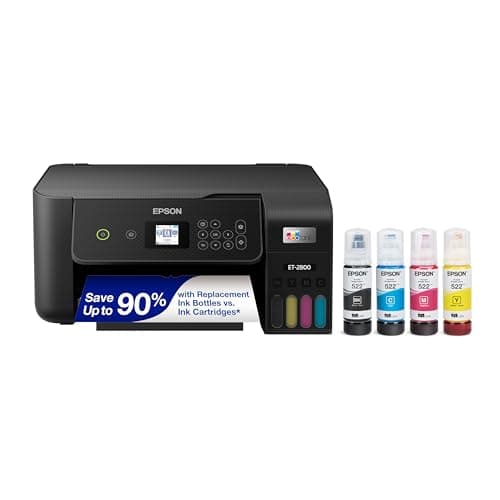
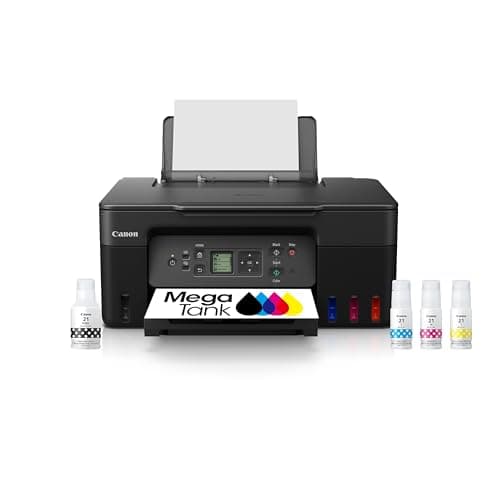
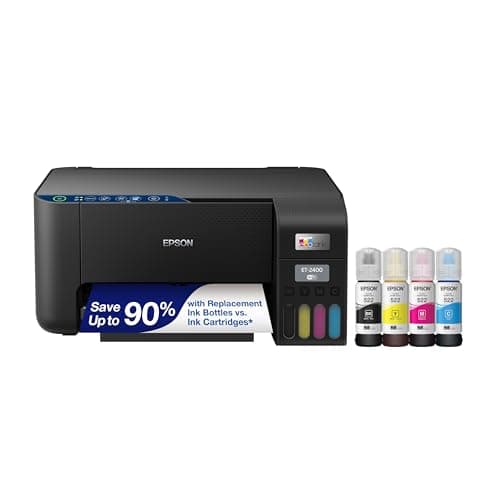
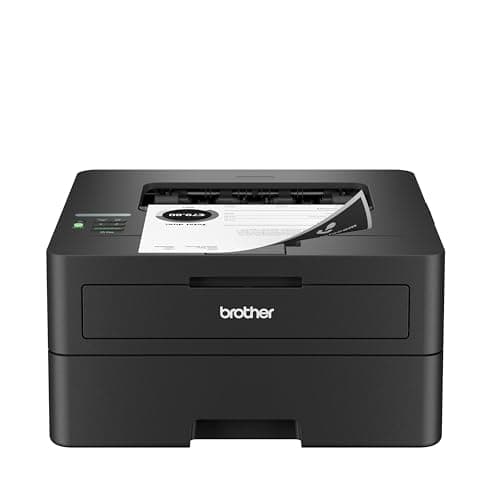
The top pick is the Epson EcoTank ET-2800, for any household that wants to stop buying cartridges: no cartridge anywhere in the machine, ink from refillable 522 bottles, about 0.4 of a cent a mono page. The budget pick is the EcoTank ET-2400, the cheapest route into the same bottles. And if what you actually meant was “a printer that does not use liquid ink,” the Brother HL-L2460DW is a different answer to a different problem, and we have ranked it as such.
Which printers do not use cartridges?
Refillable ink tank printers. Epson sells them as EcoTank, Canon as MegaTank and HP as Smart Tank. Instead of a chipped cartridge, ink comes in bottles you pour into transparent tanks built into the printer, so you can see what is left. Laser printers still use a cartridge, but it holds dry toner rather than liquid ink and there is no subscription attached to buying one.
How we picked
Two different searches land on this page, so we ranked for both and labeled which pick answers which.
- Is there a cartridge in the machine at all? A truly cartridge-free printer takes ink from a bottle into a built-in tank. Our top three do. That is the strict reading of the question, so it is the one we lead with.
- Can the supply be locked out by firmware? This is usually the real reason behind the search. A bottle has no chip to authenticate, so no update can decide your ink is counterfeit. How printer DRM actually works.
- What does a page cost? Every figure here is our own arithmetic: published supply price divided by the manufacturer’s rated page yield. We show the inputs and the sources.
- Is there a subscription anywhere near it? None of these four requires or pushes one, which is the whole point of this hub.
Bottles or toner: the question behind the question
“Printer without cartridges” is two searches wearing one phrase. One group has been burned by cartridge prices and chip authentication and wants ink in a bottle. The other has been burned by a dried-out printer and wants no liquid ink in the house. The machines that serve those two people are not the same, and a roundup that pretends otherwise sends half its readers to the wrong printer.
| Refillable ink tank | Mono laser | |
|---|---|---|
| What the supply is | Ink in a plastic bottle | Dry toner in a cartridge |
| Chip that can be rejected | No chip to reject | Possible, but no plan attached |
| Prints color | Yes | No, on the models here |
| Survives months unused | Usually, with occasional use | Yes, reliably |
| Cost per mono page | ~0.3-0.4¢ | ~3.3¢ on high-yield toner |
| Cost per ISO color page | ~0.8-1.1¢ | Not applicable |
Cost figures are our arithmetic on dated published supply prices — the method. Yields are manufacturer-rated at ISO coverage, so treat these as the floor rather than your real cost.
If you print color at all, take the bottles. If you print black text and the printer will sit idle for weeks between jobs, take the laser. If you genuinely do both, the honest answer is two printers, which sounds absurd until you price three years of cartridge ink. The full inkjet versus laser comparison.
Why bottles are cheap, in one paragraph
It is not that bottles are cheap. It is that bottles are enormous. A 522 black bottle costs $17.99 and is rated at 4,500 pages. A high-yield cartridge for a cheap inkjet costs around the same and is rated in the hundreds. Nothing clever is happening — you are buying ink by volume instead of by container.
That changes the shape of the purchase. A cartridge printer is cheap on day one and expensive for the rest of its life; a tank printer is the reverse, and the crossover arrives sooner than most buyers expect, often inside the first year for a household printing a few hundred pages a month. Put your own volume in and you will see where your crossover lands.
The one trap in this category
Not every tank printer is free of chips or of selling. HP’s Smart Tank line is bottle-fed but still lives inside HP’s software ecosystem, and HP has an ink subscription it would like you to join. Bottle-fed is not the same as subscription-free, and the two are easy to conflate when the box says “tank.” What each brand actually requires goes through the policies one at a time.
Who should not buy a cartridge-free printer
If you print under about twenty pages a month and will keep doing so for years, the ink economics may never repay the hardware premium, and a very cheap laser like the Canon imageCLASS LBP6030w — about 6.1 cents a page on the Canon 125 cartridge — can be the cheaper total. If you need an automatic document feeder or two-sided printing, you will have to move up the range; the tank printers with automatic duplex is the page for that, and the ones with a document feeder for the other half.