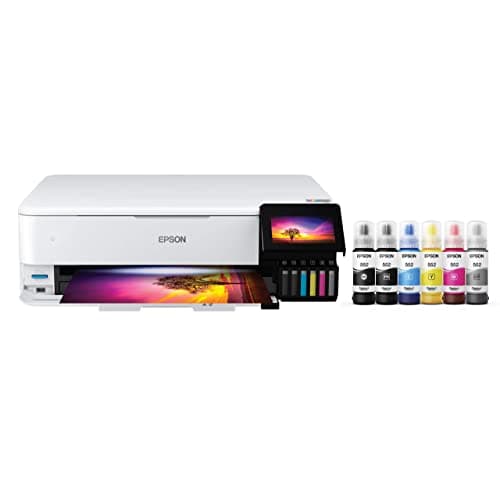
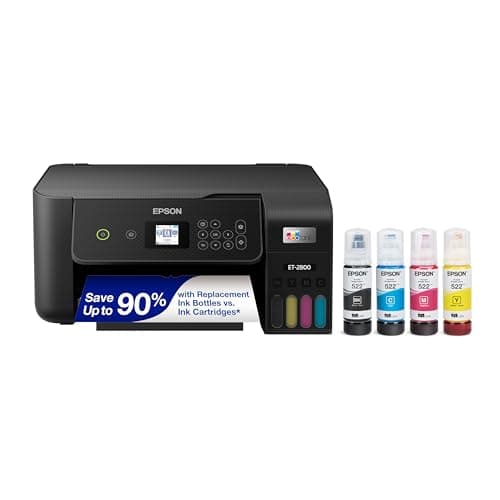
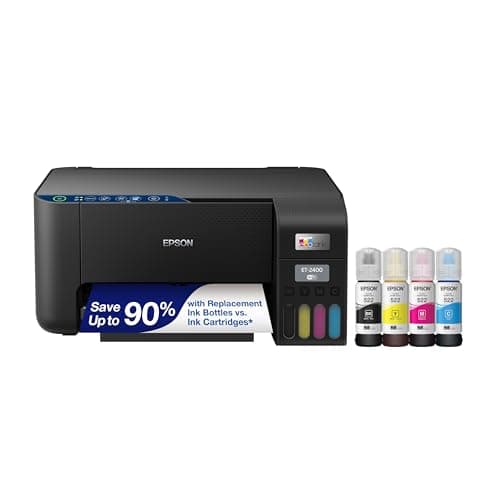
The printer to buy for art prints is the Epson EcoTank Photo ET-8550: it is the only machine we cover with a six-color ink set including a photo black and a gray channel, the only one publishing borderless output to 13 by 19 inches, and the only one with a single-sheet straight-through paper path for heavy stock. The budget pick is the EcoTank ET-2400, which prints a color page at about 1.1 cents and leaves the money for paper. But read the next paragraph before you buy anything.
Can you print real giclee art prints at home?
Not with any printer on this page, and we would rather say so. A giclee is a pigment print, usually on cotton rag or similar fine-art stock, and its selling point is archival permanence. Of the printers we cover, Canon publishes a pigment ink on exactly one machine and it is the black only, described for water resistance on plain paper. Epson publishes no pigment designation at all for the six-color 552 Claria ET Premium set on the ET-8550 — we checked Epson’s own product page on 25 November 2026 and neither “dye” nor “pigment” appears on it. And no maker publishes a fade-resistance or print-permanence rating for any ink in our registry. What these machines are very good at is printing your own work beautifully and cheaply for yourself, for gifts, and for proofing before an edition goes to a lab.
How we picked
We have no units, no lab, no colorimeter and no test prints, so you will find no verdict here about which machine makes a prettier image — that would be invented. What we can do is read what the manufacturers publish, notice what they conspicuously do not publish, and do the arithmetic on ink. For art prints specifically, four things decide it.
- How many ink channels, and are a photo black and a gray among them? This is the specification that separates an art-capable printer from a color printer. A gray channel is what keeps neutral tones neutral; a photo black is what makes a deep black on coated stock rather than a muddy one. One machine here has both; the rest have four inks.
- Will it take the paper, and how does the paper travel? Art stock is heavy and often textured. A curved paper path cracks it; a straight-through single-sheet path does not. Only the ET-8550 publishes one.
- Is there an archival claim? For anyone selling prints this is the number that matters, and the honest finding is that none of our makers publishes one. We treat that as a result, not as something to paper over.
- What does a print cost? Our own arithmetic on dated published bottle prices. This is where bottle-fed printers transform the activity — proofing becomes free enough to actually do.
Pigment versus dye, and why the word matters
Inkjet inks come in two broad families. Dye inks dissolve in their carrier, sit in the paper and are generally praised for vivid color on glossy stock. Pigment inks suspend solid particles that sit on the surface, and they are the family associated with water resistance and with archival print life — which is why fine-art printing is overwhelmingly pigment printing, and why “giclee” is effectively shorthand for a pigment print on fine-art paper.
Here is the complete, honest state of that question across the printers we cover:
| Printer | Channels published | Photo black / gray | Pigment designation published |
|---|---|---|---|
| Epson EcoTank Photo ET-8550 | Six-color 552 Claria ET Premium | Yes - photo black and gray | None. Neither 'dye' nor 'pigment' appears on Epson's page |
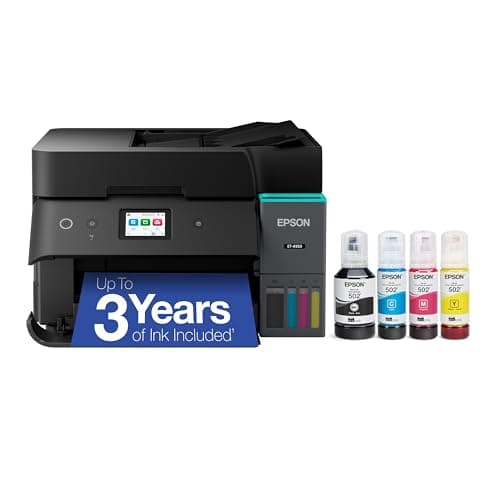
| Epson EcoTank ET-4950 | Four-color 502 | No | None published |
| Epson EcoTank ET-2800 / ET-2400 | Four-color 522 | No | None published |
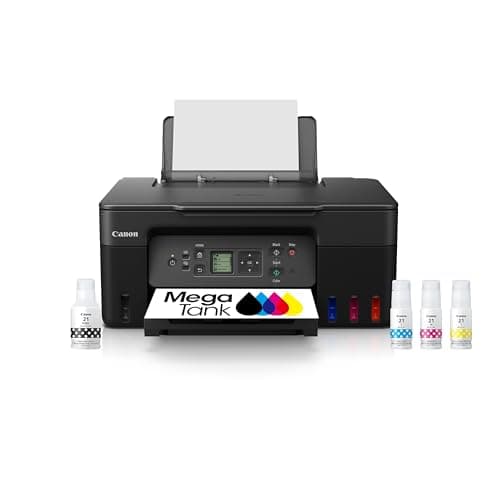
| Canon PIXMA MegaTank G3270 | Four-color GI-21 | No | Yes - but the BLACK only, for water resistance on plain paper |
Channel counts and ink family names are published by the makers on the pages listed in our sources. The pigment column records what the manufacturer states, not what we infer: “none published” means the designation is absent from the page we read, not that the ink is one or the other. Epson’s ET-8550 page was re-read on 25 November 2026 specifically to check this.
The practical conclusion is narrow and useful. If a buyer asks whether your print is a giclee, none of these machines lets you say yes with a straight face. If you are printing for yourself, for gifts, for a craft fair at modest prices, or to proof before committing to an edition, the top pick does genuinely lovely work at a cost per sheet a lab cannot approach.
The number nobody publishes
Fine-art printing has an established vocabulary for permanence — display life under glass, light-fastness ratings, accelerated fade testing. None of the makers in our registry publishes such a rating for the inks on this page, and we are not going to borrow a number from somewhere it was not measured.
What that means in practice, stated plainly so you can make your own decision:
- For your own walls, it is a non-issue. Out of direct sunlight, behind glass, the realistic risk is low and the print cost is so small that reprinting in a few years is trivial.
- For sold work, disclose rather than guess. Describe what it is — an inkjet print on your named paper — and do not use the words giclee or archival unless the ink maker backs them. Buyers of art are entitled to accuracy, and a claim you cannot source is the one that comes back.
- For an edition, use a lab. A print studio will tell you the exact printer, ink set and paper, and that documentation is part of what the buyer is paying for.
Paper is the upgrade, and the paper path is the limit
If you take one thing from this page beyond the giclee question, take this: at every price level here, the paper changes the output more than the printer does. The same file on plain office stock and on a coated art paper are not comparable objects, and the gap costs cents rather than hundreds of dollars.
What constrains you is the paper path. Heavy, textured stock does not like being bent. The ET-8550 is the only machine we cover that publishes a rear single-sheet straight-through path alongside its 100-sheet main tray, 20-sheet 5 by 7 photo tray and rear feed — that straight path is precisely the feature that lets a thick sheet go through flat. Every other printer here feeds from a curved tray, which is why we would not promise you any of them will take a heavy art stock.
- Check the maker’s supported media list before buying a pack of paper, not after. Thickness limits are real and a jam on expensive stock is an expensive jam.
- Feed heavy sheets one at a time. On the top pick that is what the straight path is for; on the others it is a hopeful experiment.
- Buy a sample pack before a ream. Matte, luster and glossy behave differently with the same ink, and your own eye on your own image settles it faster than any review.
Our cardstock page works through the same paper-path problem on the laser side, and the invitations roundup covers heavy folded stock specifically.
What printing your own art actually costs
This is where bottle-fed machines change the activity rather than just the bill. A cartridge printer makes every test print a small financial decision; these do not.
| Printer and ink | ISO color page | Three years of ink |
|---|---|---|
| Canon MegaTank G3270, GI-21 | ~0.8¢ | $58 |
| EcoTank ET-2800 / ET-2400, 522 | ~1.1¢ | $81 |
| EcoTank ET-4950, 502 | ~1.2¢ | $85 |
| EcoTank Photo ET-8550, six-color 552 | ~1.4¢ | $102 |
Our own arithmetic: bottle price divided by the manufacturer’s rated page yield, counting the black channel plus three color channels, using prices read on 27 September 2026, at the ISO 5% coverage standard. An artwork is not an ISO page. A full-bleed image covers far more of the sheet and will cost a multiple of these figures — treat the rows as a comparison between machines, not as the price of a print.
Two things fall out of it. The six-color machine is not dramatically dearer to feed than the four-color ones — it is dearer to buy. And the spread across all four is small enough that ink cost should not decide this purchase; channels, paper path and print size should. Every tank printer’s cost per page shows the full working.
When a lab beats everything here
Three cases, and they are common enough that leaving them out would make this page dishonest. If you are producing a numbered edition, a lab gives you documented ink and paper, which is part of the product. If you need anything larger than 13 by 19 inches, no machine here reaches it. And if you print a handful of large pieces a year, a lab is cheaper once you count the printer.
Home printing wins when the volume is regular and the sizes are modest: proofing, small prints, cards, zines, packaging inserts, work sold at accessible prices. That is a real and sizeable use, and the arithmetic above is why. Our ink tank picks for photographs and photo printers under $500 cover the neighboring questions, and the sticker page handles coated sticker stock specifically.