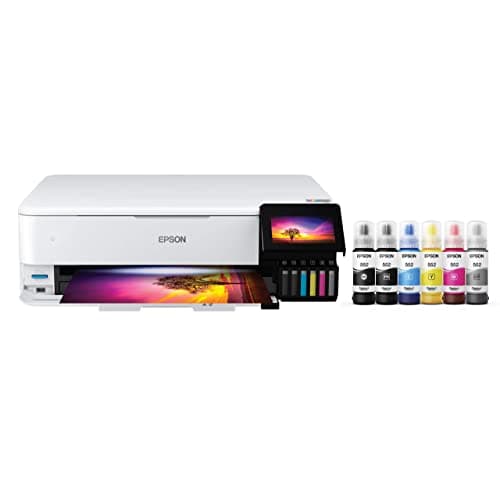
This is the only printer we cover where the sticker price is the honest headline. Seven hundred and fifty dollars is a lot of money for a home printer, and no amount of cost-per-page arithmetic makes it a sensible default. What the arithmetic does do is show the volume at which it stops being an extravagance — and for anybody printing photographs in quantity, that volume is lower than it sounds. Here is every input, and a plain list of the people who should buy something else.
Cost to run
The ET-8550 is filled from the Epson 552 bottle family. Epson rates the Epson 552 black ink bottle at 6,700 pages at ISO/IEC 24712, and we read $23.99 for it on Epson’s own store on 27 September 2026. That is about 0.4 of a cent a black page. Each color bottle is rated at 6,200 pages at $21.99, which puts a four-channel ISO color page at about 1.4 cents.
Hold that against the published figures for the kind of machine this printer is meant to replace. Cartridge inkjet color runs about 20 cents a page, per Toner Buzz. At about 1.4 cents the ET-8550 lands at roughly a fourteenth of that. On a page of text the gap is small in absolute terms; on a page covered edge to edge in ink, which is what a photograph is, the gap is the entire argument for the printer.
| If you print | Ink over 3 years | Total with the printer |
|---|---|---|
| 50 pages a month | $6 | $756 |
| 200 pages a month | $26 | $776 |
| 500 pages a month | $64 | $814 |
Supplies only in the middle column; sticker price plus supplies in the right one. Mono pages at the manufacturer’s rated yield and the supply price we read on 27 September 2026. Real cost runs higher because rated yields assume 5% page coverage. The full method.
Read the right-hand column and the shape of this printer becomes obvious. The ink is a rounding error at every volume in the table. The printer is almost the entire cost of owning it for three years at any household rate of printing. That is the opposite of how the rest of this site works, and it is why the honest question about the ET-8550 is never “what does it cost per page” but “do I print enough photographs to justify the hardware.” Put your own volume in rather than taking our word for it.
Why six bottles instead of four
The cheaper EcoTanks use four channels: cyan, magenta, yellow and one black. The ET-8550 adds two. A photo black, which is a different ink formulated for glossy and luster photo stock rather than plain paper, and a gray channel, which exists to keep neutral tones neutral instead of letting them drift green or magenta the way a black-plus-color mix tends to.
That is a genuine print-quality difference rather than marketing, and it is also why a photograph off this printer costs more per sheet than the plain-paper figure above implies: a photographic print draws from six bottles, not four. Epson publishes the gray bottle at a very high rated yield precisely because an ordinary page barely touches it.
The trade is six bottles to buy and store rather than four. At the rated yields that is not a frequent errand — the black alone is good for 6,700 rated pages — but it is six line items rather than four when a set runs down together. How bottle-fed refilling actually works.
Borderless, and the 13 by 19 question
This is the only printer in our registry that publishes borderless printing, and it does it up to 13 by 19 inches — A3+. If you print your own photographs, sticker sheets, art prints or anything that needs ink to the edge of the sheet, that single specification is most of the reason to buy this machine rather than a cheaper EcoTank. On every other printer we cover, edge-to-edge artwork means designing with a margin and trimming it off afterwards.
Epson publishes a 100-sheet plain-paper input tray, a secondary tray for twenty sheets of 5 by 7 photo paper, a rear feed that takes 50 plain sheets or 5 sheets of A3+ photo stock, and a single-sheet straight-through path for the thickest media. The 5 by 7 tray is the quietly useful one: greeting cards and small prints live there permanently while plain paper stays in the cassette. Our ink tank picks for photo printing sets out what the cheaper alternatives give up, and our invitation and greeting card picks explain why that 5 by 7 tray matters more than the ink set for anyone printing cards.
Speed, and the two-sided penalty
Epson rates it at 16.0 ISO ppm black and 12.0 ISO ppm color one-sided, and 6.0 and 5.0 ppm respectively with automatic two-sided printing switched on. Those are inkjet numbers and they are the price of liquid ink. Any mono laser on this site puts a stack of text out several times faster.
For photographs this is irrelevant — a 13 by 19 print takes minutes on any machine and nobody buys a photo printer by the minute. For paperwork it is a real limitation, and it is one of several reasons this is a poor choice as a household’s only printer if that household mostly prints documents. Inkjet against laser is the page for that decision.
Scanning, and the missing feeder
The scanner is a good one on paper: a flatbed rated at 1200 by 4800 dpi hardware resolution, which is the specification that matters if you are digitizing prints or film-era snapshots rather than receipts. It also reads SD cards and USB memory.
What it does not have is an automatic document feeder. At this price that is a genuinely annoying omission and it is worth being blunt about: if a meaningful part of your scanning is multi-page documents, this is the wrong machine, and a cheaper EcoTank with a feeder will make you happier. Ink tank printers that do have a document feeder.
Against the EcoTank you probably want
| ET-8550 | ET-2800 | ET-4950 | |
|---|---|---|---|
| List price | $749.99 | $239.99 | $499.99 |
| Ink channels | Six (552) | Four (522) | Four (502) |
| Borderless | Yes, to 13 by 19 in | Not published | Not published |
| Document feeder | None | None | Published |
| Wired Ethernet | Yes | No | Yes |
| Mono cost per page | ~0.4¢ | ~0.4¢ | ~0.3¢ |
| Color cost per page | ~1.4¢ | ~1.1¢ | ~1.2¢ |
Prices and hardware read from each model's own page on epson.com; the ET-8550 column re-read on 4 November 2026. Cost per page is our arithmetic on the Epson store bottle prices in our sources. 'Not published' means Epson does not state the feature on that model's specification page, which is not the same as a confirmed absence.
The table makes the decision for most people. The cheap EcoTank is within a whisker of the expensive one on cost per page, because they are all drinking from bottles. What the $510 difference buys is the six-color ink set, borderless output and the wide format — three photo features and nothing else. If none of those three words describes what you print, buy the ET-2800 and spend the difference on paper.
The thing every tank printer owner should know
Liquid ink in an inkjet head dries if it sits still, and a six-channel head has more to lose than a four-channel one. Epson runs automatic cleaning cycles, and those cycles consume ink. A printer used weekly is fine; a printer that sits untouched for two months and is then asked for a perfect 13 by 19 print may want a cleaning cycle or two first.
This is the best single reason not to buy this printer for occasional use. A $749.99 photo machine printing six photographs a year is both the most expensive and the most fragile way to get those six photographs. What clogging actually is, and how to avoid it — and if your printing really is sporadic, what to buy instead.
No subscription, no plan, no enrollment
There is nothing to cancel and nothing to sign up for. Epson sells 552 bottles outright, the printer prints having never been connected to an account, and there is no per-page allowance to run out of mid-job. For a reader arriving here from a cartridge printer that stopped working when a plan lapsed, that is the whole point. Epson printers without a subscription and EcoTank against HP Instant Ink.
On third-party ink the honest position is narrower than many buyers expect. Epson’s tank printers refill from bottles rather than chipped cartridges, so there is no cartridge to lock out — but Epson’s warranty language and its guidance on non-Epson ink are worth reading before you buy a cheaper bottle. Epson and third-party ink, with sources.
What we checked, and when
On 4 November 2026 Epson’s own US product page listed the ET-8550 at $749.99 with an add-to-cart button and no discontinued notice, and the retailer offer our price button points at was live below that list price. We report that as a dated snapshot rather than a promise: the button on this page goes to a live listing precisely so you read today’s price and availability rather than ours. Printers at this end of the range discount irregularly and sometimes heavily.
Who should buy something else
- You print documents, with photographs as a rare treat. The ET-2800 is $239.99 and within a whisker of this machine on cost per page. Spend the $510 on anything else.
- You need to scan multi-page documents. There is no feeder here at all. The ET-4950 and the rest of our ADF picks cost less and do more paperwork.
- You print rarely. A six-channel inkjet head is the worst possible thing to leave idle. A small mono laser is the right answer for sporadic printing and costs a fraction of this.
- You want the lowest color cost per page, full stop. The Canon MegaTank G3270 is cheaper to buy and cheaper per color page, with a pigment black that smudges less on plain paper. It will not print borderless or 13 by 19.
- You print a handful of photographs a year. A print shop or an online photo service will do them better, on better paper, for less than the depreciation on this printer. We would rather say that than sell you a machine you do not need.