
Skip to content
Tank & Toner
A sheet of bright color print output on a pale desk

By Use Case

Best printers for invitations and greeting cards

Printing your own invitations is not a print-quality problem. It is a paper-path problem, a bleed problem and a short-run arithmetic problem - and the printer that solves all three is not the one most guides recommend.

By Ryder M. · Published November 4, 2026

Quick picks

Our ranked picks for best printers for invitations and greeting cards, with the cost per page beside each one. Tap a row to jump to the full write-up.

Our ranked picks for best printers for invitations and greeting cards, with the cost per page beside each one. Tap a row to jump to the full write-up.
#ProductBest forCost per pagePrice
1
Epson EcoTank Photo ET-8550 — Amazon product photo
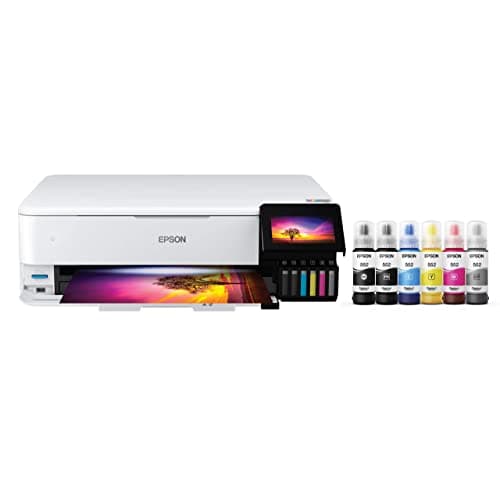
Epson EcoTank Photo ET-8550Borderless to 13 by 19 inches, a 5 by 7 photo tray, six-color ink, about 1.4¢ an ISO color page
Best for invitations~0.4¢
2
Brother HL-L3220CDW — Amazon product photo
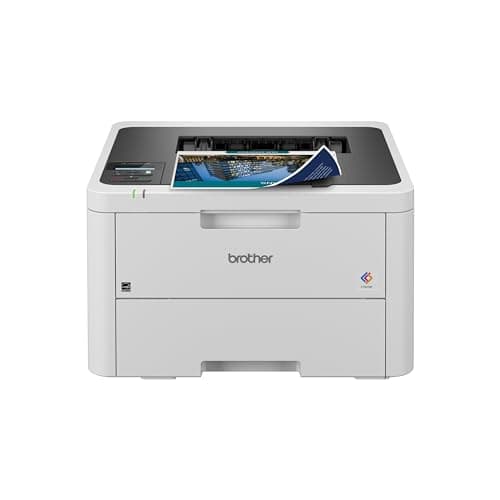
Brother HL-L3220CDWColor laser, output dry enough to fold and stack immediately, automatic duplex
Best for folded cards in quantity~3.2¢
3
Epson EcoTank ET-2800 — Amazon product photo
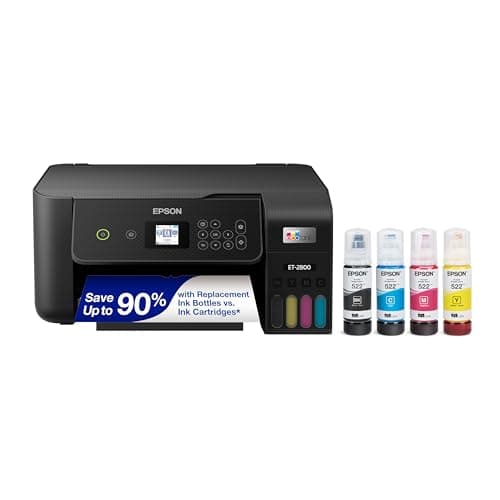
Epson EcoTank ET-2800$239.99, about 1.1¢ an ISO color page, and no cartridges to buy ever again
Cheapest sensible way in~0.4¢
4
Canon PIXMA MegaTank G3270 — Amazon product photo
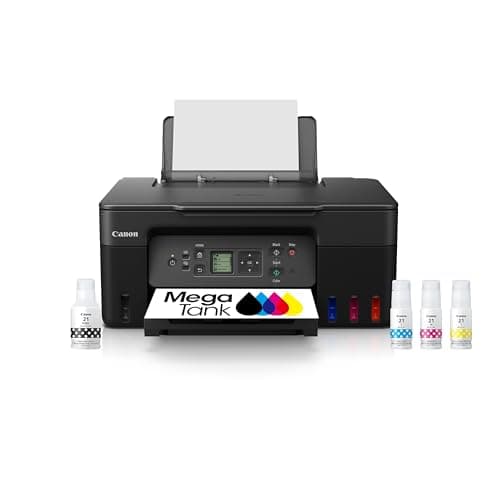
Canon PIXMA MegaTank G3270Pigment black ink and the lowest color cost per page we have found, about 0.8¢
Best for cards that get handled~0.3¢
5
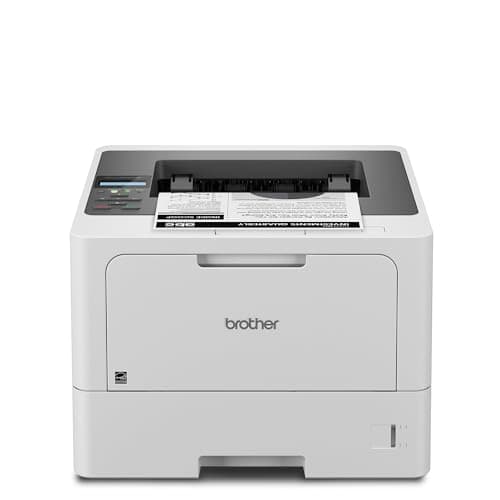
Brother HL-L5210DW — Amazon product photo
Brother HL-L5210DWA real 100-sheet second input, 48 ppm, about 1.9¢ a page
Best for black-ink cards and envelopes in volume~1.9¢

#ad — buy links are affiliate links and we may earn a commission at no cost to you. How this site is funded. Prices as shown on Amazon as of November 12, 2026; Amazon’s own page is the price of record. Cost-per-page figures are arithmetic on supply prices we read on 27 September 2026 — here is the method.

Search for a printer for wedding invitations and you will be shown photo printers ranked by resolution. Resolution is almost never what goes wrong. A card is a small, heavy, folded sheet printed in a run of fifty, and the things that actually ruin the job are a paper path that will not take the stock, a white margin you cannot get rid of, and ink that is still wet when you want to fold. Those are the three criteria this page ranks on, and we finish by making the case for not printing them at home at all.

How we picked

Cards are different enough from paperwork that the usual ranking does not apply. These are the four questions we put to every printer here, in the order they decide the purchase.

  1. Where does the card stock go? A printer with one input tray means unloading plain paper every time you print a card, and a tight paper path means heavy stock jams or comes out curled. We only list machines where the manufacturer publishes a second input, a manual feed slot or a straight-through path for thick media.
  2. Can it print to the edge? Borderless is a printer feature, not a paper feature. Only one model in our registry publishes it. On everything else, edge-to-edge color means designing a bleed and trimming every card, which on fifty cards is a real afternoon.
  3. Is it dry when it comes out? Toner is fused on and finished. Liquid ink on coated card needs a moment, and a stack of freshly-printed cards is how coverage gets smudged. This is the main reason a color laser appears on an otherwise inkjet-leaning page.
  4. What does a run of fifty cost? Cards are heavy ink coverage, which is the single most expensive thing you can ask a cartridge printer to do. Every figure we quote is our own arithmetic on dated published supply prices, and we show the inputs.

The borderless problem, stated plainly

This is the one thing we would want a card printer to have and the one thing almost nothing publishes. Of the printers in our registry, only the EcoTank Photo ET-8550 states borderless printing, up to 13 by 19 inches. For every other machine on this page, the honest instruction is: design the card oversized with the background running past the trim line, print it, then cut it down. A guillotine or a paper trimmer costs very little and does a better job than scissors.

“Not published” is not the same as “cannot.” Some printers do more than their specification sheets say. But we are not going to tell you a $240 printer will print to the edge of your invitation on the strength of a guess, because you would find out the expensive way, fifty sheets of card in.

What a run of fifty cards actually costs in ink

Here is where a tank printer earns its place. An ISO color page is rated at 5% coverage; an invitation with a colored background is nothing like that, so treat the figures below as the floor rather than the answer. The ratio between the columns is what survives the coverage problem, and the ratio is enormous.

Ink or toner for a 50-card run, at rated ISO color coverage
PrinterCost per ISO color pageFifty cards
Canon MegaTank G3270~0.8¢$0.40
Epson EcoTank ET-2800~1.1¢$0.56
Epson EcoTank Photo ET-8550~1.4¢$0.71
Published cartridge inkjet average~20 cents a pageabout $10.00

Our arithmetic: the bottle price divided by the manufacturer’s rated yield, at the prices in our sources. The cartridge row is the published industry average from Toner Buzz rather than a specific printer. All four are ISO 5% coverage figures, so a real invitation costs several times as much on every row. The method.

The point of that table is not the pennies. It is that the ink for a card run is effectively free on a bottle-fed printer and a real line item on a cartridge one — and card printing is a repeating habit. Save-the-dates, then invitations, then thank-you notes, then next year’s Christmas cards.

The paper decides more than the printer does

Two things about card stock are worth knowing before you buy any printer.

The first is that laser and inkjet want different coated papers, and they are not interchangeable. Photo and card stock sold for inkjet is coated to absorb liquid ink; laser stock is made to survive being fused with heat. Buy the stock that names your printer type on the packet, and if a sheet is sold for inkjet photo printing, do not feed it through a laser.

The second is weight. Manufacturers publish a media weight range for each paper path, and the heavy end of it is usually the manual feed or straight-through route rather than the main cassette. If you have a specific stock in mind, find its weight on the packet and check it against the paper path you intend to use on that model’s own specification page. That is a two-minute check that prevents the most common card-printing complaint there is. Our cardstock roundup goes through the published second-input options on the laser side.

Folded cards, and why automatic duplex matters here

A folded greeting card is a two-sided print on one sheet, and that makes automatic two-sided printing worth more on this page than on any other. Without it, every card is fed twice and oriented correctly by hand, and on a run of fifty the error rate is not zero. Of the picks above, the HL-L3220CDW and the HL-L5210DW publish automatic duplexing; the ET-8550 publishes it too, at the slower two-sided speed. Epson does not publish it on the ET-2800.

If you are folding, score the fold rather than creasing it cold, and fold away from the printed side. That is paper-craft advice rather than printer advice, and it does more for the look of a home-made card than any specification on this page. What duplex printing is, and when it is worth paying for.

Why the card looks wrong on the first try

The commonest disappointment with home-printed invitations has nothing to do with the printer. A screen emits light and a card reflects it, so a deep navy on a monitor comes out lighter and flatter on paper, and a pale blush can disappear entirely. Print one card before you print fifty — on the actual stock, not on plain paper, because the coating changes the color as much as the ink does.

Six-color ink sets, like the 552 set in the ET-8550, help most in the places four-color sets struggle: skin tones on a photo card, and neutral grays that otherwise drift green or magenta. For flat design work in strong colors, a four-channel tank printer is perfectly good and a quarter of the price. Our photo printing picks cover the ink-type question in more depth.

For one wedding, a print shop or an online stationery service will almost certainly beat you. They print on stock you cannot buy in a five-pack, they cut dead straight, they can emboss and foil and die-cut, and a hundred invitations is a small order rather than an afternoon. If invitations are a one-off life event, that is the better answer and we are not going to pretend otherwise.

Printing at home wins in three situations. When you are iterating — proofs, several designs, a change of date. When the run is small and repeated — a greeting card business, monthly orders, place cards for a dinner. And when you already need a printer for everything else, in which case card printing is a free capability that comes with a machine you were buying anyway. That last case is most readers, and it is why the ET-2800 is on this list.

If cards are becoming a side business rather than a hobby, the economics tip further toward owning the printer, and the pages to read next are our sticker and craft picks and the small business tank roundup.

One thing not to buy

Do not buy a subscription printer for card printing. A card is a high-coverage page, and subscription plans are priced in pages rather than ink: fifty invitations is fifty pages off your monthly allowance whether each one is a line of text or solid color edge to edge. That is the worst possible arrangement for exactly this job, and it is before the question of what happens to the printer if you stop paying. Color printers without a subscription · why page allowances suit card printing badly.

Specifications and running costs side by side, for the printers discussed on this page.
PrinterSupply typeMono per pageColor per pageAuto duplexFeederPrice
Epson EcoTank Photo ET-8550Ink bottles~0.4¢~1.4¢YesNo$604.90 · View on Amazon$749.99 · 19% off
Brother HL-L3220CDWToner~3.2¢not publishedYesNo$284.99 · View on Amazon
Epson EcoTank ET-2800Ink bottles~0.4¢~1.1¢NoNoCheck price on Amazon
Canon PIXMA MegaTank G3270Ink bottles~0.3¢~0.8¢Not statedNo$199.99 · View on Amazon$248.99 · 20% off
Brother HL-L5210DWToner~1.9¢mono onlyYesNo$329.99 · View on Amazon

#ad — the price buttons are affiliate links and we may earn a commission at no cost to you. How this site is funded. Prices as shown on Amazon as of November 12, 2026; Amazon’s own page is the price of record.

Cost-per-page figures are our own arithmetic: supply price divided by the manufacturer’s rated page yield, using prices read on 27 September 2026 and yields rated at the ISO 5% coverage standard. They are not measured by us and they are not current prices. Every input, and the working · run the numbers for your own printing

The picks in detail

Best for invitations

Epson EcoTank Photo ET-8550

The only printer here bought for photographs rather than paperwork. It is expensive to buy and remarkably cheap to feed, which is the whole argument for it.

Epson EcoTank Photo ET-8550 — Amazon product photo

Product photograph supplied by Amazon for this listing. We do not have this model in hand and have not photographed it ourselves.

$604.90 · View on Amazon$749.99 · 19% off

#ad — we may earn a commission. How this site is funded. Prices as shown on Amazon as of November 12, 2026; Amazon’s own page is the price of record.

~0.4¢ per mono page · ~1.4¢ per color page

Based on a Epson 552 black ink bottle rated at 6,700 pages at $23.99, priced on 27 September 2026.

The color figure adds one per-page cost for each of the three color channels, because an ISO color page draws from all of them.

  • Epson 552 black ink bottle — rated 6,700 pages (ISO/IEC 24712), $23.99 at Epson US, checked 27 September 2026
  • Epson 552 color ink bottle — rated 6,200 pages (ISO/IEC 24712), $21.99 at Epson US, checked 27 September 2026

Yields are manufacturer-rated at the ISO 5% page-coverage standard, not measured by us, and real-world cost runs higher. Prices are not live: this is arithmetic on a price we read on the date shown, not a current price. How we calculate cost per page.

List price
$749.99 at Epson US, checked 27 September 2026
Supply type
Refillable ink bottles
Two-sided printing
Automatic
Document feeder
None
Connectivity
Wi-Fi, wired Ethernet (10/100) and Hi-Speed USB
Subscription
None required

What we like

  • Six-color ink set with a dedicated photo black and a gray channel
  • Prints borderless up to 13 by 19 inches
  • Bottle-fed, so heavy photo printing does not mean a cartridge bill

What you give up

  • By far the highest sticker price on this site
  • No automatic document feeder, so a stack of pages is one lid-lift each
  • Overkill unless photographs are the main reason you are buying

This is the only printer in our registry that publishes borderless printing, which on an invitation is not a nicety. A card with a colored background and a white strip down one edge looks like a mistake, and without borderless the only fixes are to design a margin in on purpose or to print oversized and trim every card by hand. Epson publishes borderless output up to 13 by 19 inches here.

The second specification that matters is quieter: a secondary tray holding twenty sheets of 5 by 7 photo paper, plus a rear feed and a single-sheet straight-through path for the thickest media. A 5 by 7 tray is a card tray. Your stock lives there while plain paper stays in the 100-sheet cassette, so printing six more invitations does not mean unloading the printer. The six-color 552 ink set, with a photo black and a gray channel, is what keeps a photographic save-the-date from going muddy.

Honest cons. It is $749.99, which is more than the invitations. There is no document feeder. Epson rates it at 16.0 ISO ppm black and 12.0 color, dropping to 6.0 and 5.0 two-sided, so a run of fifty folded cards is a sit-down job. And it is a large machine to keep on a desk for a once-a-year wedding. The full cost-to-run breakdown.

Specifications read from the manufacturer’s own product page on 27 September 2026. Full cost-to-run breakdown for the Epson EcoTank Photo ET-8550 →

Best for folded cards in quantity

Brother HL-L3220CDW

A color laser that will not dry out between jobs. Buy it for occasional color that has to be crisp, not for cheap color - a tank printer wins on cost by a wide margin.

Brother HL-L3220CDW — Amazon product photo

Product photograph supplied by Amazon for this listing. We do not have this model in hand and have not photographed it ourselves.

$284.99 · View on Amazon

#ad — we may earn a commission. How this site is funded. Prices as shown on Amazon as of November 12, 2026; Amazon’s own page is the price of record.

~3.2¢ per mono page

Based on a Brother TN229XL black high-yield toner cartridge rated at 3,000 pages at $96.29, priced on 27 September 2026.

  • Brother TN229XL black high-yield toner cartridge — rated 3,000 pages (ISO/IEC 19798), $96.29 at Brother USA, checked 27 September 2026

Yields are manufacturer-rated at the ISO 5% page-coverage standard, not measured by us, and real-world cost runs higher. Prices are not live: this is arithmetic on a price we read on the date shown, not a current price. How we calculate cost per page.

List price
$284.99 at Brother USA, checked 27 September 2026
Supply type
Toner cartridge
Print speed
Up to 19 pages per minute in black and in color
Two-sided printing
Automatic
Document feeder
None
Connectivity
Wireless
Subscription
None required

What we like

  • Color laser output does not dry out during long idle spells
  • Auto duplex printing
  • Four separate cartridges, so one exhausted color does not mean replacing the set

What you give up

  • Color toner is expensive per page next to any ink tank printer
  • Four cartridges to replace instead of one
  • Slower than the mono lasers at 19 pages per minute

A laser fuses dry toner onto the sheet, so a card comes out of this printer finished. You can fold it, stack it, stuff it into an envelope and run your thumb along the crease straight away. On an inkjet a run of fifty cards wants laying out while the ink sets, and heavy color coverage on coated stock is exactly where wet ink smudges and curls. If your job is a hundred folded Christmas cards on a Sunday afternoon, this is the machine that does not slow you down.

Brother lists the HL-L3220CDW at $284.99 with automatic two-sided printing and the TN229 cartridge family. Automatic duplex matters more on cards than people expect: a folded card is a two-sided print, and doing it by hand means feeding every sheet twice in the right orientation.

Honest cons. Color laser pages are dear — about 3.2 cents for black alone, and a color page considerably more — so this is the opposite of the cheap-per-page argument the rest of this site makes. There is no scanner, no borderless printing, and four cartridges plus a drum to replace rather than one. Photographic images will look like a laser printed them. What it costs to run.

Specifications read from the manufacturer’s own product page on 27 September 2026. Full cost-to-run breakdown for the Brother HL-L3220CDW →

Cheapest sensible way in

Epson EcoTank ET-2800

The cheapest way to get genuinely low-cost color printing at home, as long as you can live without an auto duplexer or a document feeder.

Epson EcoTank ET-2800 — Amazon product photo

Product photograph supplied by Amazon for this listing. We do not have this model in hand and have not photographed it ourselves.

Check price on Amazon

#ad — we may earn a commission. How this site is funded. Prices as shown on Amazon as of November 12, 2026; Amazon’s own page is the price of record.

~0.4¢ per mono page · ~1.1¢ per color page

Based on a Epson 522 black ink bottle rated at 4,500 pages at $17.99, priced on 27 September 2026.

The color figure adds one per-page cost for each of the three color channels, because an ISO color page draws from all of them.

  • Epson 522 black ink bottle — rated 4,500 pages (ISO/IEC 24712), $17.99 at Epson US, checked 27 September 2026
  • Epson 522 color ink bottle — rated 7,500 pages (ISO/IEC 24712), $17.99 at Epson US, checked 27 September 2026

Yields are manufacturer-rated at the ISO 5% page-coverage standard, not measured by us, and real-world cost runs higher. Prices are not live: this is arithmetic on a price we read on the date shown, not a current price. How we calculate cost per page.

List price
$239.99 at Epson US, checked 27 September 2026
Supply type
Refillable ink bottles
Two-sided printing
Manual only
Document feeder
None
Connectivity
Wireless
Subscription
None required

What we like

  • Among the lowest cost per page of any printer sold for home use
  • Refillable bottles, so no chipped cartridge can be locked out by firmware
  • Comes with enough ink in the box to last most households a long time

What you give up

  • No automatic two-sided printing, so paper costs twice what it needs to
  • Flatbed scanner only - no document feeder for multi-page scans
  • Inkjets still need to be used occasionally or the print head can clog

If the honest answer is “I want to print cards occasionally and I do not want to spend much,” this is it. At $239.99 it is the cheapest route to bottle-fed color on this site, and at about 1.1 cents an ISO color page the ink stops being a consideration — which matters on cards, because a card is heavy coverage and heavy coverage is where cartridge printers hurt.

For flat cards, tags, place cards and anything you are happy to trim, it does the job for a quarter of the price of the ET-8550. We point most households here for everything else they print, too.

Honest cons. Epson does not publish borderless printing or automatic two-sided printing on this model, so edge-to-edge means trimming and a folded card means feeding each sheet twice by hand. There is one input tray, so card stock displaces your plain paper. And it is a dye-ink machine, so a card that gets handled a lot is better off on a pigment black. Our ET-2800 page.

Specifications read from the manufacturer’s own product page on 27 September 2026. Full cost-to-run breakdown for the Epson EcoTank ET-2800 →

Best for cards that get handled

Canon PIXMA MegaTank G3270

The cheapest cost per page of any printer we cover, and the pigment black is the reason to pick it over an EcoTank if your prints get handled.

Canon PIXMA MegaTank G3270 — Amazon product photo

Product photograph supplied by Amazon for this listing. We do not have this model in hand and have not photographed it ourselves.

$199.99 · View on Amazon$248.99 · 20% off

#ad — we may earn a commission. How this site is funded. Prices as shown on Amazon as of November 12, 2026; Amazon’s own page is the price of record.

~0.3¢ per mono page · ~0.8¢ per color page

Based on a Canon GI-21 pigment black ink bottle rated at 6,000 pages at $17.99, priced on 27 September 2026.

The color figure adds one per-page cost for each of the three color channels, because an ISO color page draws from all of them.

  • Canon GI-21 pigment black ink bottle — rated 6,000 pages (ISO/IEC 24712 (Canon default print mode)), $17.99 at Target, checked 27 September 2026
  • Canon GI-21 color ink bottle — rated 7,700 pages (ISO/IEC 24712 (Canon default print mode)), $12.99 at Target, checked 27 September 2026

Yields are manufacturer-rated at the ISO 5% page-coverage standard, not measured by us, and real-world cost runs higher. Prices are not live: this is arithmetic on a price we read on the date shown, not a current price. How we calculate cost per page.

List price
$248.99 at Office Depot, checked 27 September 2026
Supply type
Refillable ink bottles
Two-sided printing
Not stated on the spec page we read
Document feeder
None
Connectivity
Wireless
Subscription
None required

What we like

  • Lowest cost per page of any model on this site, mono and color
  • Pigment black ink smudges less on plain paper
  • Large 170 mL bottles, so refills are infrequent

What you give up

  • Canon's own store would not show us a price, so ours is a retailer listing
  • No document feeder
  • Canon's headline yields assume its default print mode, not draft mode

Canon fills this one with a pigment black rather than a dye black, which is more water-resistant on plain paper and smudges less under a thumb. Invitations get handled: posted, opened, stuck on a fridge, passed round a table. For a card with a lot of black text on it, that is a real advantage over the Epsons.

It is also the cheapest printer to run in our registry on both mono and color pages — about 0.3 of a cent black and about 0.8 cents for an ISO color page — from large 170 mL GI-21 bottles, so a long run of cards costs almost nothing in ink.

Honest cons. Canon does not publish borderless printing, automatic two-sided printing or a document feeder for this model on the pages we read, and Canon’s own store would not show us a price, so our figure is a retailer listing. There is one paper input. Canon’s headline yields assume its default print mode rather than draft. The G3270 in full.

Specifications read from the manufacturer’s own product page on 27 September 2026. Full cost-to-run breakdown for the Canon PIXMA MegaTank G3270 →

Best for black-ink cards and envelopes in volume

Brother HL-L5210DW

The cheapest way onto Brother's business toner family, which is the real reason to buy it: the cartridge is roughly half the cost per page of the household models.

Brother HL-L5210DW — Amazon product photo

Product photograph supplied by Amazon for this listing. We do not have this model in hand and have not photographed it ourselves.

$329.99 · View on Amazon

#ad — we may earn a commission. How this site is funded. Prices as shown on Amazon as of November 12, 2026; Amazon’s own page is the price of record.

~1.9¢ per mono page

Based on a Brother TN920XXL super high-yield toner cartridge rated at 11,000 pages at $204.29, priced on 29 September 2026.

  • Brother TN920XXL super high-yield toner cartridge — rated 11,000 pages (ISO/IEC 19752), $204.29 at Brother USA, checked 29 September 2026

Yields are manufacturer-rated at the ISO 5% page-coverage standard, not measured by us, and real-world cost runs higher. Prices are not live: this is arithmetic on a price we read on the date shown, not a current price. How we calculate cost per page.

List price
$329.99 at Brother USA, checked 29 September 2026
Supply type
Toner cartridge
Print speed
Up to 48 pages per minute
Two-sided printing
Automatic
Document feeder
None
Connectivity
Gigabit Ethernet, dual-band wireless (2.4 GHz / 5 GHz) and Hi-Speed USB 2.0
Subscription
None required

What we like

  • TN920XXL toner works out at roughly half the cost per page of the household TN830XL
  • A genuine second paper source - a 100-sheet multi-purpose tray, not a one-sheet slot
  • 48 pages a minute with auto duplex and Gigabit Ethernet

What you give up

  • Print only - no scanner, no copier, no fax
  • $150 more than the HL-L2460DW before you buy any toner
  • A replacement cartridge is a $200-plus purchase, even though each page is cheaper

Not every card is in color. Black or a single dark ink on heavy cream stock is a whole invitation aesthetic, and the matching envelopes have to be addressed by something. This is the cheapest machine we cover that publishes a genuine second paper source: a 100-sheet multi-purpose tray above the 250-sheet main cassette, 350 sheets across two inputs. Card stock and envelopes can live in that tray permanently.

Brother lists it at $329.99 with automatic two-sided printing on Letter and Legal, 48 pages a minute, and the TN920XXL cartridge rated at 11,000 pages — about 1.9 cents a page, roughly half what Brother’s household toner costs. Our envelope picks go into the paper path in more detail.

Honest cons. It prints black and nothing else, which rules it out for most invitation designs outright. It is print only — no scanner, no copier. The replacement cartridge is a $200-plus purchase even though each page off it is cheap. And Brother’s own store showed it out of stock when we last checked, so availability is worth confirming. The HL-L5210DW page.

Specifications read from the manufacturer’s own product page on 29 September 2026. Full cost-to-run breakdown for the Brother HL-L5210DW →

Questions people actually ask

What is the best printer for wedding invitations at home?

The Epson EcoTank Photo ET-8550, if you are buying for the job: it is the only printer in our registry that publishes borderless printing, and it has a 5 by 7 photo tray and a straight-through path for thick stock. If $749.99 is more than the invitations are worth, the $239.99 EcoTank ET-2800 prints the same cheap color pages and you trim the edges yourself.

Can a regular printer print on card stock?

Usually, within the media weight range the manufacturer publishes for the paper path you are using — and the heavy end of that range is almost always the manual feed or rear tray rather than the main cassette. Check the weight on the packet against that model’s specification page before buying stock.

Is a laser or an inkjet better for greeting cards?

A laser if you are folding and stacking in quantity, because toner comes out dry and finished. An ink tank printer if the design is photographic or needs to reach the edge of the card, and for cost: a color laser page is several times the price of a tank page.

Do I need borderless printing for invitations?

Only if the design has color running to the edge. If it does, and your printer does not publish borderless, print the card oversized with a bleed and trim it down — a paper trimmer costs very little and gives a cleaner edge than scissors.

How much does it cost to print 50 invitations at home?

In ink, far less than people expect on a bottle-fed printer — cents rather than dollars at rated ISO coverage, and a few dollars at the heavy coverage a real invitation uses. The card stock will cost you considerably more than the ink. On a cartridge printer the ink becomes the bigger half of the bill.

Can you print your own greeting cards to sell?

Yes, and the arithmetic works better than for a one-off wedding, because the printer is amortized over many runs. A bottle-fed printer is close to essential: heavy color coverage repeated weekly is the scenario cartridge costs punish hardest.

Sources