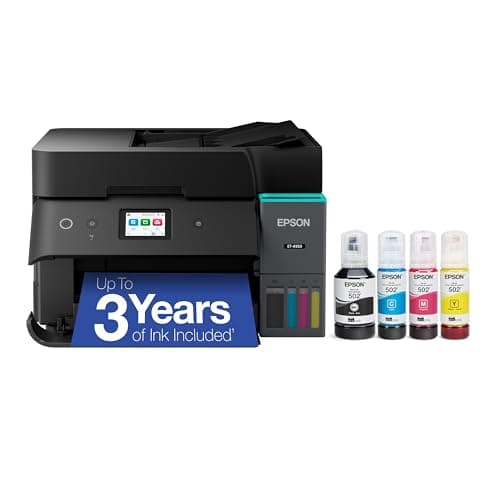
The ET-4950 is the EcoTank for people who stopped shopping on price. It has the document feeder, the automatic duplexer, the wired network port and the fax modem that the cheap tank printers leave out, and it runs on Epson’s cheapest black ink. It also lists at $499.99, which is more than twice what the ET-2800 costs to print an almost identical page. Whether that is a good buy comes down to three features, and this page is about working out whether you need them.
Cost to run
This printer refills from the 502 bottle family. The Epson 502 black ink bottle is rated at 7,500 pages at ISO/IEC 24712 and was $24.99 on Epson’s own store when we read it, which is about 0.3 of a cent a page. A full ISO color page draws from all four channels: black plus three Epson 502 color ink bottles rated at 6,000 pages at $16.99 each, so about 1.2 cents.
Those numbers are small enough to be hard to believe, so here is the comparison that makes them real. A mono laser at the good end of normal runs about 3.3 cents a page. This printer prints a black page for roughly a tenth of that, and a full-color page for about a third of what the laser charges for black alone.
| If you print | Ink over 3 years | Total with the printer |
|---|---|---|
| 50 pages a month | $6 | $506 |
| 200 pages a month | $24 | $524 |
| 500 pages a month | $60 | $560 |
Supplies only in the middle column; sticker price plus supplies in the right one. Mono pages at the manufacturer’s rated yield and the supply price we read on 27 September 2026. Real cost runs higher because rated yields assume 5% page coverage. The full method.
Read down the middle column first. Three years of black ink at 500 pages a month costs less than a single high-yield toner cartridge. That is the whole case for a tank printer, and it is why the right-hand column is dominated by the printer price at every volume — which in turn is why the $499.99 list price is the only serious objection to this machine. Put your own volume in.
502 ink is not cheaper at everything
Epson sells two bottle families across the EcoTank range, and most write-ups treat the 502 as simply the better one. On black pages that is true: about 0.3 of a cent against about 0.4 of a cent for the 522 bottles that feed the ET-2800 and the ET-4800.
On a full ISO color page it is the other way round, narrowly. The 502 color bottles are rated at 6,000 pages each against the 522’s 7,500, which works out at about 1.2 cents a color page here against about 1.1 cents on the 522 machines. The difference is a fraction of a cent and it will not change anybody’s decision, but we would rather print it than let a tidy claim stand unexamined.
| Bottle | Rated yield | Price we read | Printers |
|---|---|---|---|
| Epson 502 black ink bottle | 7,500 pages | $24.99 | ET-4950 |
| Epson 502 color ink bottle | 6,000 pages | $16.99 | ET-4950, each of cyan, magenta and yellow |
| Epson 522 black ink bottle | 4,500 pages | $17.99 | ET-2800, ET-2850, ET-4800 |
| Epson 522 color ink bottle | 7,500 pages | $17.99 | ET-2800, ET-2850, ET-4800, each color |
Rated at the ISO 5% coverage standard, so your real cost will be higher. Our method in full.
What the extra money actually buys
Three features separate this machine from the EcoTanks at half the price, and it is worth being blunt about each.
- Automatic two-sided printing. The real one. The ET-2800 and the ET-4800 do not have it, which means every double-sided document is either a manual re-feed or twice the paper. At a few hundred pages a month a duplexer saves more paper than most people expect, and it is the feature we would pay for first. What duplex printing is and what it saves.
- A document feeder. Epson names an automatic document feeder on the product page we read, alongside the flatbed scanner, so a multi-page original becomes one action instead of a stack of lid-lifts. Epson does not publish the feeder’s sheet capacity on that page, and does not state whether it scans both sides in one pass, so we do not tell you either figure. If one-pass two-sided scanning is the reason you are buying, confirm it with Epson first.
- Ethernet. A printer on a cable does not disappear from the network when the router reshuffles its channels, which is the single most common complaint about shared household printers. If more than two people print to this machine, the port is worth real money.
The fax modem is the fourth feature and almost nobody should pay for it. Faxing survives in medical offices, parts of legal practice and a handful of government forms. If none of those is your life, it is dead weight.
The ink in the box, and what the claim means
Epson states the printer comes with enough ink to print up to 6,600 pages in black and 5,500 in color, and describes that as up to three years of ink. Both halves of that deserve unpacking.
The page figures are rated at the ISO 5% coverage standard, which is roughly a third of a page of double-spaced text. Print denser documents, photos, or anything with a colored background, and you will reach the bottom of the tanks sooner — that is true of every yield claim from every manufacturer and it is not a criticism of this one. The three-year framing assumes a specific monthly volume that Epson does not print next to the claim, so treat it as a marketing horizon rather than a schedule.
What is genuinely unusual is the shape of the deal: the ink in the box is worth a meaningful fraction of the printer price, which is the opposite of the cartridge model where the starter supply is deliberately small. There is no chip to argue with, no cartridge to be locked out and no plan to decline. Printers that come with usable amounts of ink.
Speed, and the honest comparison with a laser
Epson rates this printer at 18 ISO pages per minute in black and 9 in color. That is normal for a tank printer and slow next to any mono laser — the Brother MFC-L2820DW is rated at 34 pages a minute, and the business models at 48 and 50. If you print long documents under time pressure, that gap is the thing you will notice, not the cost per page.
The other inkjet caveat is idleness. A tank printer wants using every week or two; leave it for two months and the print head can need cleaning cycles that consume ink. A laser does not care how long it sits. That single difference decides the recommendation for a lot of households. EcoTank versus laser, worked through properly.
One note on buying it
Epson’s own store showed this model out of stock, with a notify-me button, when we checked on 21 October 2026, while there was a live Amazon offer for it on the same day. That is a snapshot and it will change. The practical advice is that $499.99 is Epson’s list price rather than the going rate, and the gap between the two moves around, so check the live figure rather than either number — which is what the buy button above shows you.
The subscription question
There is nothing to decline. Epson sells a subscription called ReadyPrint, and it applies to its cartridge printers. The EcoTank range refills from bottles you buy outright, whenever you like, from whoever you like. That is the cleanest version of the distinction this site exists to draw: one brand, two business models, and you choose which one you are buying into at the shelf. Epson printers without a subscription.
Because the ink arrives in a bottle, there is also no chip to authenticate and nothing for a firmware update to reject. That is a structural guarantee rather than a brand promise, and it is a stronger position than any cartridge printer can offer. Epson and third-party ink.
Who should buy something else
- You do not need the duplexer, the feeder or Ethernet. The ET-2800 lists at $239.99 and prints a black page for about 0.4 of a cent. For most households that is the right printer and the difference is better spent on paper.
- You want the feeder and Ethernet but not the duplexer. The ET-4800 has the feeder, the wired port and the fax on 522 ink, and Epson did not publish automatic duplex for it on the page we read.
- You print in bursts and then leave it for months. Buy a laser. An inkjet left idle can need head cleaning that costs ink, and this is the honest account of how often that actually happens.
- You print mostly black text, in volume, fast. A mono laser is three times the speed and indifferent to neglect. The Brother MFC-L2820DW is the all-in-one version at $279.99, and the HL-L6210DW is the cheapest laser page we have calculated.
- You print photos. This is a four-ink document printer. A photo-first EcoTank uses a six-bottle set with photo black and gray, and the photo ink tank picks explain what that costs per sheet.