
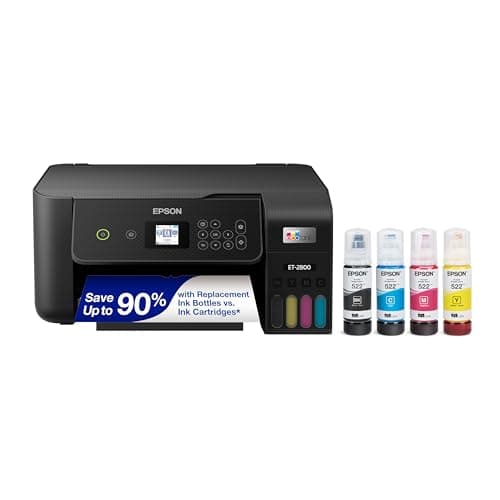
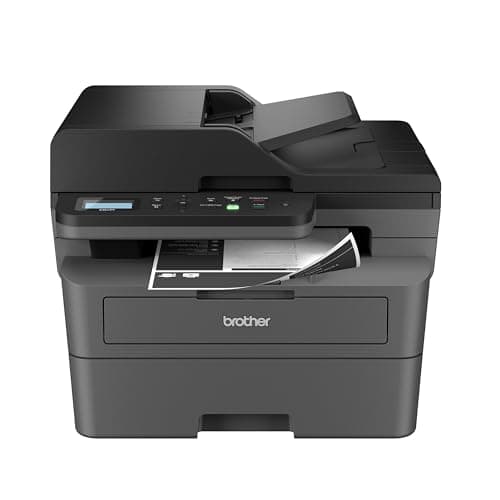
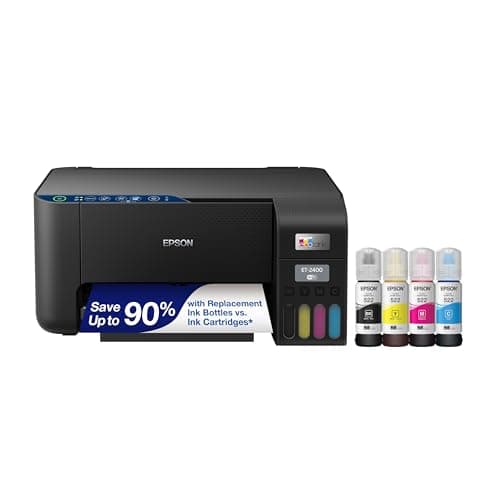
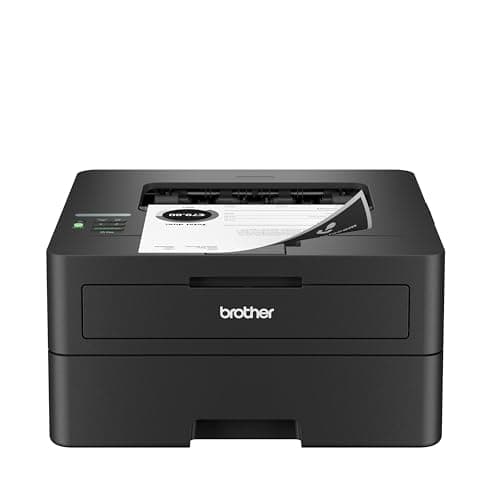
The printer to buy for home use is the Epson EcoTank ET-2800: it fills from bottles instead of cartridges, costs about 0.4 of a cent a mono page and about 1.1 cents an ISO color page, and Epson asks for no subscription. If everything your house prints is black text, buy the Brother DCP-L2640DW instead — toner cannot dry out while the printer sits unused. The budget pick is the EcoTank ET-2400, which runs on identical ink at an identical cost per page for less money.
What is the best printer for home use?
The Epson EcoTank ET-2800, for most households. It prints, scans and copies, it refills from 522 bottles bought outright rather than cartridges, and at about 0.4 of a cent a mono page it is roughly a twentieth of the about 7.5 cents a page that Toner Buzz publishes for cartridge inkjets. If your household prints black text and little else, a mono laser such as the Brother DCP-L2640DW is the better answer, because toner cannot dry out between jobs.
How we picked
Home printing is a different problem from office printing and most roundups rank it on office criteria. A household does not print 500 pages a month evenly; it prints nothing for three weeks and then a school project, two returns labels and a boarding pass in one evening. These are the four questions we asked.
- Will it work after a month of being ignored? This is the single biggest difference between a printer a household likes and one it resents. Toner is a dry powder and cannot evaporate; an inkjet nozzle can. It is why a laser appears this high on a page about home use.
- What does a page cost? Every figure here is our own arithmetic on dated published supply prices: the supply price divided by the manufacturer’s rated yield. The spread across this page is enormous — from about 0.3 of a cent to about 6.1 cents for one black page.
- Is there a subscription anywhere in the path? Every printer on this page can be bought, filled and used with no account and no monthly fee. Two of the makers sell optional plans; none of the machines here require one.
- Does the household actually need the scanner? Most homes scan a handful of documents a year and a phone camera does it. We say so rather than charging you for a flatbed you will use twice.
What five years of home printing costs
Forty pages a month is a realistic household figure, and it is the number that exposes the trap at the cheap end of the market. This table is ink or toner only — the sticker price is on the buy buttons above, because it moves.
| Printer and supply | Per page | Five years of supply |
|---|---|---|
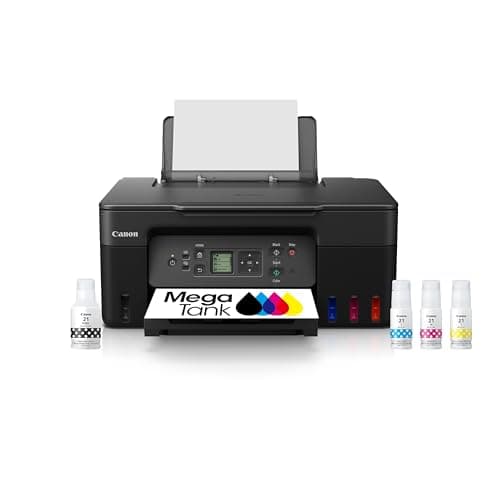
| Canon MegaTank G3270, GI-21 bottles | ~0.3¢ | $7 |
| Epson EcoTank ET-2800 / ET-2400, 522 bottles | ~0.4¢ | $10 |
| Brother DCP-L2640DW / HL-L2460DW, TN830XL | ~3.3¢ | $79 |
| A cheap mono laser on the Canon 125 cartridge | ~6.1¢ | $145 |
Our arithmetic: supply price divided by the manufacturer’s rated page yield, using the prices and yields recorded in our supply list and read on 27 September 2026. Yields are rated at the ISO 5% coverage standard, so real-world cost will be higher. Color pages cost more on every row.
The last row is the point. A printer body can be the cheapest thing in the shop and still be the most expensive object in the house, because the cartridge it takes costs more than the machine. Five years of very light household printing on that supply costs $145; the same printing on bottles costs $7. The cheapest printers to run, ranked works the same arithmetic across the whole registry.
Answer one question before you shop: color or not?
Nearly every home printer decision collapses once you know this. Look at what your household actually printed last month rather than what it might print.
- Black text, forms and labels, with color almost never. Buy a mono laser. It will still be working in ten years, it cannot dry out, and it does not care that you ignored it. The DCP-L2640DW if you want the scanner and feeder, the HL-L2460DW if you do not.
- Some color: school projects, craft, a photo on the fridge. Buy a tank printer. Cartridge color is the single most expensive routine purchase in home technology, and bottles end it.
- Genuinely photographic prints. Neither of the above. See our picks for printing photos at home — and consider a lab for anything you intend to frame.
Why none of these needs a subscription
“Best printer for home use no subscription” is one of the most common ways people arrive at this page, and it is a reasonable thing to insist on. A printer that stops printing with ink in it because a plan lapsed is not a printer you own.
Every machine here sidesteps that in one of two ways. The tank printers fill from bottles bought outright — Epson sells ReadyPrint for its cartridge printers, and Canon’s MegaTank models take GI-21 bottles with no plan attached. The Brother lasers take toner cartridges you buy when you need one; Brother sells a Refresh EZ Print subscription and the printers work normally without it. Nothing on this page has a cartridge chip that a firmware update can refuse. How to use a printer without a subscription covers the mechanics, and our subscription-free hub covers the rest of the range.
What to skip when buying for a home
Three features get sold hard to households and earn their money in offices instead. A document feeder matters if you scan multi-page documents regularly; most homes do not, and the flatbed on the ET-2800 handles the two a year. Fax matters if you deal with an institution that still demands it — we have a page for exactly that — and otherwise it is dead weight. Very high speed is irrelevant: the difference between 19 and 36 pages a minute is invisible on a four-page job.
The feature that is worth paying for at home is automatic two-sided printing, because it halves the paper bill on anything longer than a page and paper is the cost households forget to count. The DCP-L2640DW and HL-L2460DW both publish it; the tank printers that duplex are a shorter list.