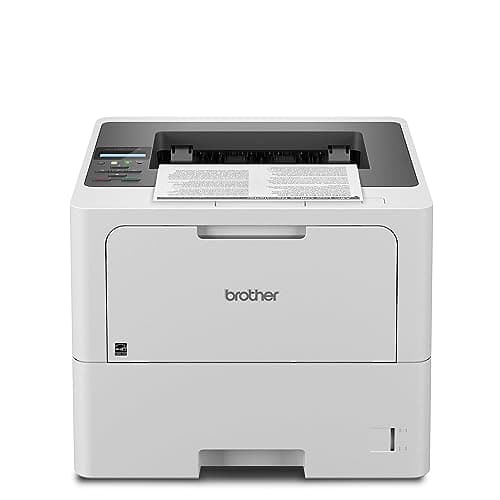
Most printer advice stops at the sticker price, which is exactly backwards for this machine. The HL-L6210DW is $349.99 — nearly twice what a perfectly good household mono laser costs — and at any volume above about a hundred pages a month it is the cheaper printer to own. The reason is one cartridge, and the rest of this page is the arithmetic behind that claim plus a plain list of the people who should buy something else.
Cost to run
Brother names two black cartridges on this model’s own specification page: the TN920 that ships in the box, rated at 3,000 pages, and the Brother TN920UXXL ultra high-yield toner cartridge rated at 18,000 pages at ISO/IEC 19752. We read $241.49 for the replacement on Brother’s store on 29 September 2026, which is about 1.3 cents a page.
Hold that figure next to the household range. The Brother TN830XL high-yield toner cartridge that feeds the HL-L2460DW, the DCP-L2640DW and the MFC-L2820DW is rated at 3,000 pages at $98.29 — about 3.3 cents. Same brand, same drum technology, same black toner on the page, and roughly two and a half times the cost for every sheet that comes out.
| If you print | Toner over 3 years | Total with the printer |
|---|---|---|
| 100 pages a month | $48 | $398 |
| 300 pages a month | $145 | $495 |
| 800 pages a month | $386 | $736 |
Supplies only in the middle column; sticker price plus supplies in the right one. Mono pages at the manufacturer’s rated yield and the supply price we read on 27 September 2026. Real cost runs higher because rated yields assume 5% page coverage. The full method.
The right-hand column is the one to read. At 100 pages a month the printer dominates the total and a $179.99 machine is the sensible buy. At 300 the two paths are close. At 800 pages a month the cartridge is the whole bill and the cheap printer has quietly become the expensive one. Put your own volume in before you take our word for where the line sits.
The 3,000-page starter cartridge
The cartridge in the box is not the cartridge the cost per page is calculated on. Brother publishes the included TN920 at 3,000 pages, so the first replacement arrives at one-sixth of the headline yield. That is disclosed on the specification sheet rather than hidden, but it does mean the first year of ownership costs more than the long-run figure suggests, and it is worth budgeting a TN920UXXL before you need one.
Brother’s wider business range includes a TN920XXL rated at 11,000 pages, which is the cartridge its sibling the HL-L5210DW ships against. It is not named on the HL-L6210DW specification page we read, so we do not tell you it fits. That is not a claim that it does not — it is a refusal to invent a compatibility fact you would spend $200 on. Buy what Brother names for your model, which here is the TN920UXXL.
Paper handling, and one specification worth reading twice
The paper path is the second reason this machine exists. Brother publishes a 520-sheet main tray — a full ream, loaded once — plus a separate 100-sheet multi-purpose tray, expandable to 1,660 sheets with optional trays. That is a genuine second paper source, not the single-sheet manual slot the household models give you. Why that distinction matters more than it sounds.
| Input | Capacity | Sizes |
|---|---|---|
| Main tray | 520 sheets | Letter, Legal, Executive, A4, A5, A6, B5, Folio (8 x 13 in) |
| Multi-purpose tray | 100 sheets | Letter, Legal, Executive, A4, A5, A6, envelopes, custom 2.75-8.5 in wide by 5-14 in long |
| Automatic duplex | n/a | Letter and Legal |
Read from the Brother USA specification page for this model on 21 October 2026.
Two things follow from that table. Legal paper works in both inputs and in the duplexer, which is unusual enough that we built a separate page on legal-size lasers around it. And the multi-purpose tray takes envelopes and heavier stock without you unloading the main tray, which is the practical difference between a second tray and a slot.
The specification worth reading twice is the headline capacity. Brother advertises a standard input figure higher than the two trays above account for. We report the two trays because those are the two trays, and we would rather you arrived at an unboxing with the right expectation than a pleasant surprise we invented. Read the tray specification, not the marketing number.
Speed, and what a duty cycle actually tells you
Brother lists up to 50 pages a minute, a first page out of standby in up to 6.7 seconds, 256 MB of memory and a 1,200 MHz processor. The first-page figure is the one you notice day to day; nobody waits for page 48.
The more useful pair of numbers is the volume rating: Brother publishes a recommended monthly print volume of up to 8,000 pages and a maximum monthly duty cycle of up to 125,000. Those are not the same claim. The recommended figure is what the machine is built to do every month for its service life; the duty cycle is the absolute ceiling the mechanism can survive. Buy against the recommended number and ignore the ceiling, which exists mostly to appear in comparison tables.
For context, 8,000 pages a month is sixteen reams. If that number sounds absurd for your house, it is — this is a small-office machine and the honest recommendation for a household is a cheaper one.
The drum unit nobody budgets for
Every laser has a second consumable. The DR920 drum unit on this model is rated at approximately 45,000 pages and is replaced separately from the toner. At 300 pages a month you will not reach it for over twelve years. At the 8,000-page recommended volume you reach it in under six months, and it becomes a real recurring line item that no cost-per-page figure on this page includes. The difference between a drum and a toner cartridge is five minutes well spent before buying any laser printer.
The subscription question
Nothing about this printer requires a plan. Brother sells an optional Refresh EZ Print subscription that ships toner automatically, and the machine prints normally having never been enrolled. You buy a cartridge, from whoever you like, and put it in. That is a different arrangement from a printer that stops working when a plan lapses, and the distinction is the reason this site exists. How automatic toner plans actually work.
On third-party toner, the honest position is that Brother is the brand most often recommended by people who want supply choice, and that in early 2025 that reputation was publicly challenged when allegations circulated that firmware updates were disabling compatible cartridges. Brother denied it directly, stating its firmware updates do not block third-party ink or toner while noting it performs a genuine-supply check during troubleshooting. We report that as a documented dispute, not a settled fact — the full account, with sources.
Networking
Gigabit Ethernet, dual-band wireless on 2.4 and 5 GHz, and Hi-Speed USB 2.0. AirPrint, Mopria, Wi-Fi Direct and Brother Mobile Connect are all named on Brother’s page, so Macs, iPhones and Android handsets print without a driver. For a shared office printer the cable is the feature: a machine on Ethernet does not vanish from the network when the router reshuffles its channels. Network laser printers covers what that is worth in a house with four people in it.
Who should buy something else
- You need to scan or copy. This is a print-only machine with no glass and no feeder. The MFC-L2820DW has a 50-page document feeder at $279.99, on the dearer household cartridge. The laser all-in-one roundup sets out the trade.
- You print under about a hundred pages a month. The HL-L2460DW is $179.99 and prints the same black pages. At low volume the $170 you save will outlast the per-page difference for years.
- You print in color. There is no color mode here to switch on. A tank printer is usually the cheaper way to get color, by a wide margin.
- You want the absolute lowest cost per page, full stop. A refillable ink tank printer beats this machine by roughly three times on mono pages. It is slower, it needs occasional use to stop the head clogging, and it is the right answer anyway for a lot of households — the comparison in full.
- You do not need the 520-sheet tray and you do want a cheaper cartridge than the household one. The HL-L5210DW is $329.99 with a 250-sheet main tray and the 11,000-page TN920XXL, at about 1.9 cents a page — the two-tray roundup sets the two side by side.